I’ve written about this before, but it was nearly five years ago. It’s worth a reminder: The Cobra Effect. Sahil Bloom reminded me on July 15. Here’s the short version, summarized nicely in a comic:
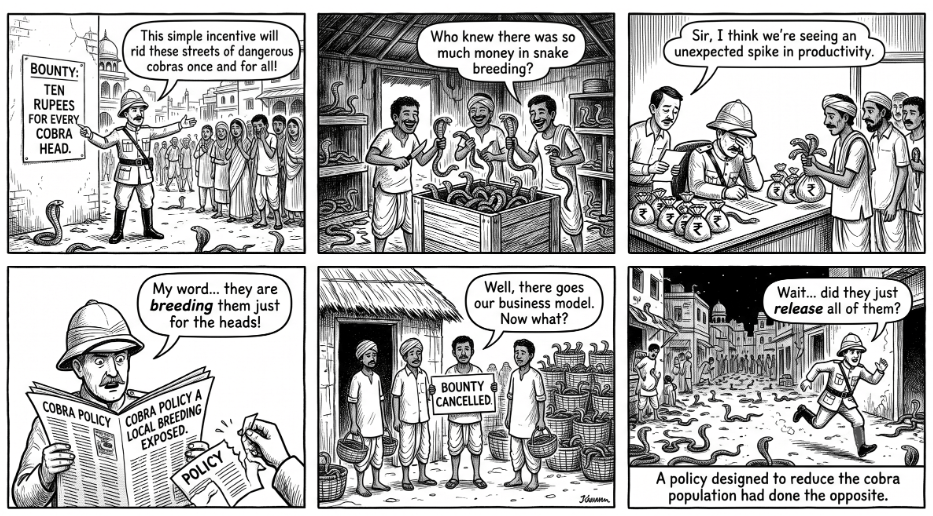
“A policy designed to reduce the cobra population had done just the opposite.” Sahil applies the story:
The Cobra Effect is an example of Goodhart’s Law, which says that when a measure becomes a target, it ceases to be a good measure.
In other words, if a measure of performance becomes a stated goal, humans will tend to optimize for it, regardless of any associated consequences.
Unfortunately, most churches illustrate this in spades: the “measure of performance” most often used is church attendance. Go to any conference where there are a lot of pastors and listen in on their conversations. True, some denominations focus on baptisms, but my friend Dan Holcomb observed in a church in which he served:
I was on staff of a church which had weekly attendance of 2,000. In the two years I was there, we baptized 800 people/year, 1,600 people in two years. And what was our weekly attendance after two years? 2,000. When 2,000 + 1,600 = 2,000, something is wrong.
Jesus told us to make disciples, not see how many folks we could get into the building. And it’s fairly clear that Jesus did not optimize for numbers:
After this many of his disciples turned back and no longer walked with him. (John 6.66, ESV)
Now great crowds accompanied him, and he turned and said to them, “If anyone comes to me and does not hate his own father and mother and wife and children and brothers and sisters, yes, and even his own life, he cannot be my disciple. Whoever does not bear his own cross and come after me cannot be my disciple. (Luke 9.25 – 27, ESV)
Jesus said to him, “If you would be perfect, go, sell what you possess and give to the poor, and you will have treasure in heaven; and come, follow me.” When the young man heard this, he went away sorrowful, for he had great possessions. (Matthew 19.21, 22, ESV)