Lessons from Dill Seeds

If you’re a regular reader of the Ewellogy, you know that I read Heather Holleman’s blog daily and use her ideas from time to time. Last Thursday she wrote about the dill seeds in her herb garden. Here’s some of what she said:

While watering the garden this morning, I noticed that dill plants have sprouted up everywhere: in the pots, by the tomatoes, around the border of the vegetable garden. The dill was supposed to stay neatly within its raised boxed garden by the fence. Dill does not listen. Dill does not obey.

I didn’t account for wind dispersing all the seeds. I didn’t think dill seeds would float everywhere and take root. It made me consider how we’re not supposed to be everywhere, go everywhere, do everything. Even though we can, we don’t have to (and perhaps we shouldn’t). God sets the boundaries of our lives and our callings, and just because our seeds could take root in all sorts of places—and even become exceedingly fruitful—it’s not always right. It’s not what God has ordained. I think about this. I want to listen. I want to obey and stay where I should.

…I uprooted the misplaced dill and sent it back to its home. I will have the most beautiful and bountiful dill garden—safe and cozy in its home near the brown fence.Heather Holleman, May 20, 2021

That’s one application: listen to the Spirit, and don’t go where you shouldn’t.

Here’s another application: John 3 – the wind is the Spirit, and he blows where he wants to.

[Jesus said, ]The wind blows where it wishes, and you hear its sound, but you do not know where it comes from or where it goes. So it is with everyone who is born of the Spirit.” (John 3.8, ESV)

It’s possible that pastors and other leaders have ideas about where their “seeds” should be planted – and want them “safe and cozy,” perhaps within the walls of the church. (Please see my blog on May 18.)

As a leader, I should be open to God leading people into places different from what I had in mind. As a seed, I should be open to blooming where I am planted. 

Heather isn’t wrong – she’s talking about dill seeds. We just have different applications.

Then he left the crowds and went into the house. And his disciples came to him, saying, “Explain to us the parable of the weeds of the field.” He answered, “The one who sows the good seed is the Son of Man. The field is the world, and the good seed is the sons of the kingdom…” (Matthew 13.36 – 38, ESV)

Now those who were scattered because of the persecution that arose over Stephen traveled as far as Phoenicia and Cyprus and Antioch, speaking the word to no one except Jews. But there were some of them, men of Cyprus and Cyrene, who on coming to Antioch spoke to the Hellenists also, preaching the Lord Jesus. And the hand of the Lord was with them, and a great number who believed turned to the Lord. (Acts 11.19 – 21, ESV)

Generous Giving

Two consecutive blogs on giving, but I can’t help it…you don’t have to be a bible scholar to know that 2 Corinthians 9 follows 2 Corinthians 8, about which I wrote yesterday. My favorite giving promises are here in chapter 9:

The point is this: whoever sows sparingly will also reap sparingly, and whoever sows bountifully will also reap bountifully. Each one must give as he has decided in his heart, not reluctantly or under compulsion, for God loves a cheerful giver. And God is able to make all grace abound to you, so that having all sufficiency in all things at all times, you may abound in every good work…Now he who supplies seed to the sower and bread for food will also supply and increase your store of seed and will enlarge the harvest of your righteousness. You will be enriched in every way so that you can be generous on every occasion, and through us your generosity will result in thanksgiving to God. (2 Corinthians 9.6 – 8, ESV, 10 – 11, NIV)

I saw this in action in my early days around The Navigators in the late 1960s. A few hundred men (mostly) would come to The Navigators Military Ministry conferences, and they would always have a Navigator staff person who was moving, maybe going overseas, that they needed to support. After presenting the specific needs (for example, $8,000 in moving expenses and $5,000/month support), Skip Gray would start, speaking slowly and deliberately, “Whoever sows sparingly, will reap also sparingly…”

They would collect the pledge cards Saturday night and report the results Sunday morning. Every time, just a few hundred people, mostly young enlisted guys, actually emulating the Macedonians Paul wrote about in chapter 8, would meet and surpass that need.

I close with another church that excelled in giving:

Moreover, as you Philippians know, in the early days of your acquaintance with the gospel, when I set out from Macedonia, not one church shared with me in the matter of giving and receiving, except you only; for even when I was in Thessalonica, you sent me aid more than once when I was in need. Not that I desire your gifts; what I desire is that more be credited to your account. I have received full payment and have more than enough. I am amply supplied, now that I have received from Epaphroditus the gifts you sent. They are a fragrant offering, an acceptable sacrifice, pleasing to God. And my God will meet all your needs according to the riches of his glory in Christ Jesus. (Philippians 4.15 – 19, NIV)

Poverty + Joy = Generosity

Look again at the title. Really? I don’t write this stuff – I just report it!

Beloved ones, we must tell you about the grace God poured out upon the churches of Macedonia. For even during a season of severe difficulty and tremendous suffering, they became even more filled with joy. From the depths of their extreme poverty, super-abundant joy overflowed into an act of extravagant generosity. For I can verify that they spontaneously gave, not only according to their means but far beyond what they could afford. They actually begged us for the privilege of sharing in this ministry of giving to God’s holy people who are living in poverty. (2 Corinthians 8.1 – 4, TPT)

Here are some simple observations:

  • Following Jesus doesn’t exempt us from “severe difficulty, tremendous suffering, and extreme poverty.”
  • Difficulties, suffering, and poverty do not have to impede joy!
  • Extreme poverty + superabundant joy = extravagant generosity.

I’ve seen it both ways: joy in Haiti, misery in the U.S. Poor people who contribute to missions, wealthy people who don’t. Perhaps the secret is in the next verse:

They exceeded our expectations by first dedicating themselves fully to the Lord and then to us, according to God’s pleasure. (2 Corinthians 8.5, TPT, emphasis mine)

Soft?

I admit it – I’m soft. I found out how soft yesterday when we visited a long-time family friend’s property in a remote area of Colorado:

  • Two-hour drive to a very small town accessible by US Highway. No problem.
  • Then 12 miles up a county road, the last three miles on dirt. Not so bad.
  • Leave our car and get into a large 4-wheel drive pick-up truck for another 2.5 miles on dirt roads made soggy by recent rains. It reminded me of riding in such a vehicle in the mountains of India, back in 2014.
  • Leave the truck and do the last 2.5 miles on two ATVs. For those of you who can’t imagine June on an ATV, I have photographic evidence!
June on an ATV in remote Colorado

Camp had an outhouse, a couple of popups, a storage trailer. No electricity. No water. Our friends have 220 acres, bordering 25,000 acres of public land where they do their elk hunting. They love it. As for June and me, we enjoyed the scenery while wondering where the amenities were!

Our friends’ hunting camp at 10,000 feet

O Lord, what an amazing variety of all you have created! Wild and wonderful is this world you have made… (Psalm 104.24, TPT)

Our “adventure” was only a day: 9 hours from when we left our house until we returned. Nothing like, say, Wycliffe missionaries who go into remote villages to live among the people and translate the scriptures. As it says on the Wycliffe site:

The extreme landscape…requires days of treacherous travel to reach many rural villages. Roads lead to rivers. Rivers lead to footpaths. Footpaths lead to remote villages . . .

I’m no Wycliffe translator, and I’m no John the Baptist either!

Now, John wore clothing made from camel’s hair, tied at his waist with a leather strap, and his food consisted of dried locusts and wild honey. A steady stream of people from Jerusalem, all the surrounding countryside, and the region near the Jordan came out to the wilderness to be baptized by him. (Matthew 3.4, 5, TPT)

As they were leaving, Jesus began to speak to the crowd about John. “What kind of man did you see when you went out into the wilderness? Did you expect to see a man who would be easily intimidated? Who was he? Did you expect to see a man decked out in the splendid fashion of the day? Those who wear fancy clothes live like kings in palaces. Or did you encounter a true prophet out in the lonely wilderness? Yes, John was a prophet like those of the past, but he is even more than that! (Matthew 11.7 – 9, TPT)

A Herald for Survivors’ Rights

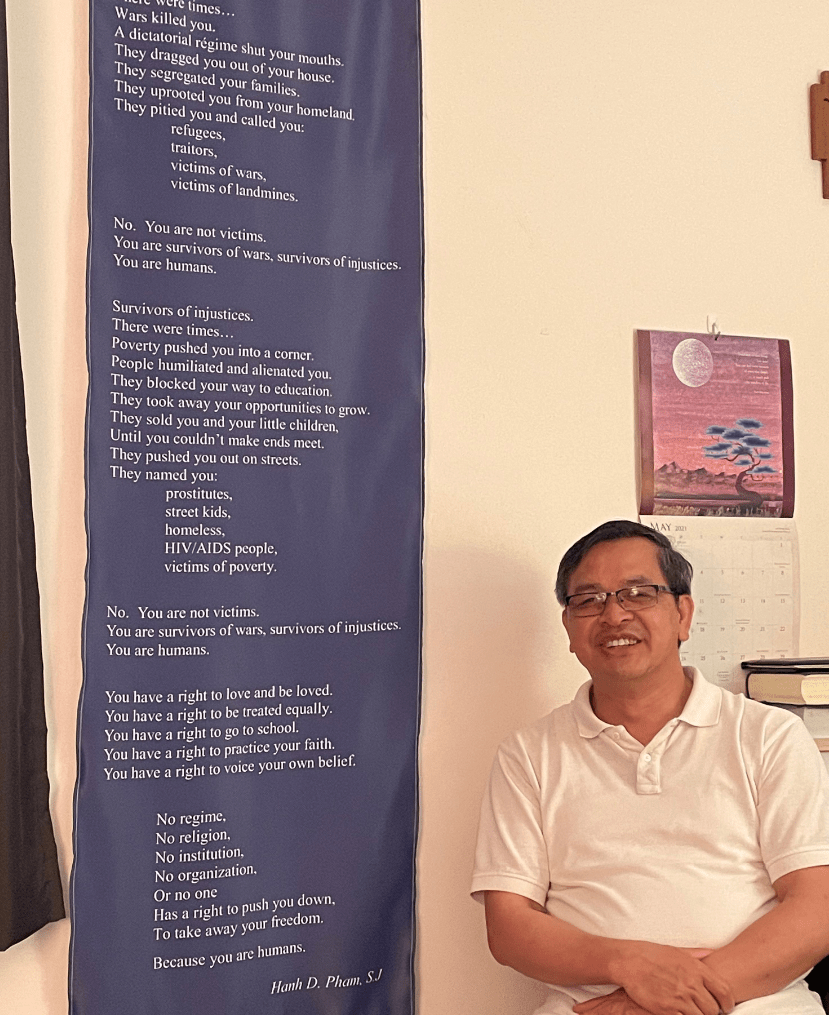
My friend Hanh Pham, a Jesuit priest from Viet Nam, showed me this poem he wrote back in 2004 after visiting Cambodia. He said the most striking thing he remembers is the number of wheelchairs at the churches. So many people with missing limbs. Hanh reminded me that Jesus still carries the wounds from the cross in his resurrected body and invited Thomas to touch them:

Then he said to Thomas, “Put your finger here, and see my hands; and put out your hand, and place it in my side. Do not disbelieve, but believe.” (John 20.27, ESV)

Hanh said that Jesus is still inviting us to “touch the wounds” of the people around us. It’s part of Jesus’ ministry and should be part of ours. For example,

As he passed by, he saw a man blind from birth…[Jesus] spit on the ground and made mud with the saliva. Then he anointed the man’s eyes with the mud and said to him, “Go, wash in the pool of Siloam” (which means Sent). So he went and washed and came back seeing. (John 9.1 – 7, ESV)

Here is Hanh’s poem, presented without further comment. It is titled “A Herald for Survivors’ Rights” and starts with “Survivors of war, There were times…”

Hanh Pham with the poem he wrote on survivors

(If you can’t see the picture, you can access the full text of the poem here.)

For I was hungry and you gave me food, I was thirsty and you gave me drink, I was a stranger and you welcomed me, I was naked and you clothed me, I was sick and you visited me, I was in prison and you came to me. (Matthew 25.35, 36, ESV)

What’s the goal?

It’s rare that you hear a report of a pastor articulating what, unfortunately, many churches are about. Steve Cleary of RevelationMedia sent out an email Sunday, March 16, talking about his stint as a youth pastor a long time ago. He had been trying to, in his words:

…speak about world missions, Christian persecution, Christ’s second coming, and our roles and callings as Christians to win the lost. We wrote letters to Christians who were imprisoned for their faith (in Russia during the Communist era), and we took opportunities to volunteer at outreach events. Of course, we also had times of fun, games, and weekend outings, but my primary goal was to help the students develop a Biblical worldview. – Steve Cleary, May 16, 2021, speaking of his goal as a youth minister years ago

It turns out some parents and even the pastor didn’t want this sort of emphasis in their youth program. Steve tried to plead his case. Finally the pastor said,

Look, your job is to keep these kids out of trouble until they grow up, get married, pay their tithe, and serve in the church. – a senior pastor to Steve Cleary, at the time, a youth minister

Really? That’s your goal? That kids grow up, get married, pay their tithe, and serve in the church? That’s what you think God requires…of you and of them?

He has told you, O man, what is good; and what does the LORD require of you but to do justice, and to love kindness, and to walk humbly with your God? (Micah 6.8, ESV)

And he gave the apostles, the prophets, the evangelists, the shepherds and teachers, to equip the saints for the work of ministry… (Ephesians 4.11, 12, ESV, emphasis mine)

New Bodies!

At age 74, I experienced this verse on Saturday:

So no wonder we don’t give up. For even though our outer person gradually wears out, our inner being is renewed every single day. (2 Corinthians 4.16, TPT, emphasis mine)

I cut the grass with my electric lawn mower (not self-propelled!) for the first time since 2017. With knee surgeries in 2018 and 2020, I’ve been using either the old tractor I got from my neighbor when he moved or I’ve hired it done. Two hours over two sessions, and I was beat! (This being the first cutting of the season, the tractor wouldn’t start.)

Anyway, I felt OK while doing it, but after, I think I feel my age. It’s a good thing the Lord promised us new bodies! These verses make more sense as I get older!

So, while living in this “tent,” we groan under its burden, not because we want to die but because we want these new bodies. We crave for all that is mortal to be swallowed up by eternal life. And this is no empty hope, for God himself is the one who has prepared us for this wonderful destiny. And to confirm this promise, he has given us the Holy Spirit, like an engagement ring, as a guarantee. That’s why we’re always full of courage. Even while we’re at home in the body, we’re homesick to be with the Master—for we live by faith, not by what we see with our eyes. We live with a joyful confidence, yet at the same time we take delight in the thought of leaving our bodies behind to be at home with the Lord. So whether we live or die we make it our life’s passion to live our lives pleasing to him. (2 Corinthians 5.4 – 9, TPT)

I try…

My mathematician friend Dr. Alexander Soifer also teaches European cinema. Occasionally he invites me to a film he showing to his class. I’ve had a hard time understanding most of them, but I’ll have to say Leviathan was an exception.

It’s a depressing story of how the corrupt mayor of a Russian village, with the help of a corrupt judicial system and a corrupt church, steals the beach-front property of a citizen. The book of Job is quoted in the film and gives the film its name – God speaking to Job:

Can you draw out Leviathan with a fishhook or press down his tongue with a cord? Can you put a rope in his nose or pierce his jaw with a hook? (Job 41.1, 2, ESV)

Although Job is quoted, it’s really the story of King Ahab stealing Naboth’s vineyard (See 1 Kings 21.) I’m writing today about a conversation between the mayor and a bishop. The mayor has been threatened with having his past misdeeds exposed, and he’s trying to get some solace from the bishop when this exchange occurs:

Bishop: “Do you go to confession and take communion?” 
Mayor: “Yes, every week without fail [ p a u s e ] I try. Of course, sometimes I am too busy.” 

It reminds me that if someone were to ask me, “Bob, do you have your time with God?” And I would reply, “Oh yes, absolutely, without fail…I try – of course, sometimes I am too busy.”

In the morning, LORD, you hear my voice; in the morning I lay my requests before you and wait expectantly. (Psalm 5.3, NIV)

Blessed are those who listen to me, watching daily at my doors, waiting at my doorway. For those who find me find life and receive favor from the LORD. (Proverbs 8.34, 35, NIV)

Getting Clean

I had an interesting experience with my smartphone the other day – somehow I got sap on the screen. We were out of town at the time so I tried some soap and water at our hotel room. Oops. Made it worse by not only not taking it off but also spreading it around. Kind of like Lady MacBeth trying in vain to get the (invisible) blood off her hands;

Out, damned spot! Out, I say! …What, will these hands ne’er be clean? – Shakespeare, Macbeth, Act 5, Scene 1.

When we got home, June suggested I try acetone as found in nail polish remover. And here’s the thing: I got the acetone and some gauze preparing to work on it for a few minutes, and as soon as the acetone-dampened gauze hit the screen, the sap disappeared. Nearly instantly! I was amazed at how fast it worked – how fast the right product worked.

What can wash away my sin? Nothing but the blood of Jesus. – Old Hymn

But if we walk in the light, as he is in the light, we have fellowship with one another, and the blood of Jesus his Son cleanses us from all sin. (1 John 1.7, ESV)

Motorboats!

Growing up in South Carolina, a lot of my friends had boats that they used for water skiing on nearby lakes. A lot of those boats were powered by Evinrude motors – a very big name in boat motors then and now. But a name is just a name, and I never gave a thought as to where Evinrude motors came from…until this week.

John Ed Mathison, whom we met yesterday told this story on his blog, Wednesday, May 12. A fellow took his girlfriend on a picnic on a Wisconsin lake. After they got there, she expressed a desire for ice cream so he rowed across the lake, 5 miles each way, to buy some ice cream. While en route, he said to himself, there’s got to be a better way to move a rowboat! And so Ole Evinrude invented an outboard motor. Here’s part of the official history:

What’s the application? John Ed’s was that we should be looking for opportunities whenever we encounter obstacles. That’s a good one. Here’s another: there’s not much a guy won’t do to catch a girl!

There are three things that are too amazing for me, four that I do not understand: the way of an eagle in the sky, the way of a snake on a rock, the way of a ship on the high seas, and the way of a man with a young woman. (Proverbs 30.18, 19, NIV)

But mainly, I think of the wonders of creative work. God has allowed humans to share in his ongoing creation from the beginning (e.g., Adam named the animals in Genesis 2). And today, people from Ole Evinrude and his descendants down to the guy who picks up your trash are serving people by their work. (I wrote about work in more detail in my third book: The Disciple’s Work.)

The LORD God took the man and put him in the Garden of Eden to work it and take care of it. (Genesis 2.15, NIV)

thoughts about life, leadership, and discipleship