What is God looking for?

My friend and former pastor John Ed Mathison, still going strong in his 80s, writes a weekly blog on Wednesdays and posts a weekly video on Mondays. This week, he was talking about profanity and how we ought not to use it because God is listening. It’s a good word with a story involving a carpenter working on a project in John Ed’s church. The carpenter couldn’t swear because “I’m in church, and God is listening.” John Ed pointed out in the video that God is everywhere.

It’s a good word, and I want to add to it, or rather, I think God wants to add to it. If God is everywhere, watching and listening, what is he watching and listening for? Just that we don’t use profanity? Not swearing is a worthy habit, but I’m afraid often we confine our self-improvement to just that, self-improvement. The day I watched the video, I read this:

6 Heartlessly they murder the widows, the foreigners, and even the orphaned children.
7 They say to themselves, “The Lord God doesn’t see this. Their God, the God of Jacob, he doesn’t even care!”
8 But you’d better watch out, you stupid fools! You’d better wise up! Why would you act like God doesn’t exist? Do you really think that God can’t hear their cries?
9 God isn’t hard of hearing; he’ll hear all their cries. God isn’t blind. He who made the eye has superb vision and he’s watching all you do. (Psalm 94.6 – 9, TPT)

God doesn’t care only that I don’t swear. He wants me to not oppress orphans, widows, sojourners, and the poor.

Thus says the LORD of hosts, Render true judgments, show kindness and mercy to one another, do not oppress the widow, the fatherless, the sojourner, or the poor, and let none of you devise evil against another in your heart. (Zechariah 7.9, 10, ESV)

For I was hungry and you gave me food, I was thirsty and you gave me drink, I was a stranger and you welcomed me, I was naked and you clothed me, I was sick and you visited me, I was in prison and you came to me. (Matthew 25.35, 36, ESV)

Seeing but not Applying

Yesterday I observed that the Philistines ran an elaborate experiment to prove that God was real, but they did not follow that discovery with worship and obedience. I noticed that the disciples were guilty of much the same thing in Mark 8. Jesus had just fed the 4,000 and been challenged by the Pharisees to produce a “sign from heaven.” (Feeding 4,000+ people isn’t enough?) In the boat with his disciples, Jesus warns them metaphorically about the Pharisees:

“Watch out for the yeast of the Pharisees.” (Mark 8.15, NIV)

The disciples, not all that bright, are trying to figure out what he’s talking about and can conclude only that they are in trouble for not bringing more bread. Here is Jesus’ rather stern response:

Knowing what they were thinking, Jesus said to them, “Why all this fussing over forgetting to bring bread? Do you still not see or understand what I say to you? Are your hearts still hard? You have good eyes, yet you still don’t see, and you have good ears, yet you still don’t hear, neither do you remember. When I multiplied the bread to feed more than five thousand people, how many baskets full of leftovers did you gather afterward?” “Twelve,” they replied. “And when I multiplied food to feed over four thousand, how many large baskets full of leftovers did you gather afterwards?” “Seven,” they replied. “Then how is it that you still don’t get it?” (Mark 8.17 – 21, TPT)

We know that God can help us and that he has helped us in the past, but we sometimes don’t apply that truth to the challenge we’re facing right now.

Fear not, for I am with you; be not dismayed, for I am your God; I will strengthen you, I will help you, I will uphold you with my righteous right hand. (Isaiah 41.10, ESV)

Belief is not commitment

I recently read the story of the Ark of the Covenant’s adventures in Philistine territory, 1 Samuel chapters 4 – 6. Go ahead and read it – I’ll wait! Here’s the short version:

  • Israel was under the leadership of Eli the high priest and his sons Hophni and Phineas. The sons were evil, and God had already predicted their soon demise. (See 1 Samuel 3.11 – 13)
  • So in chapter 4, it happened. The Israelites went battle against the Philistines and lost. So they decided to bring the Ark so that “it” might save them.

And when the people came to the camp, the elders of Israel said, “Why has the LORD defeated us today before the Philistines? Let us bring the ark of the covenant of the LORD here from Shiloh, that it may come among us and save us from the power of our enemies.” So the people sent to Shiloh and brought from there the ark of the covenant of the LORD of hosts, who is enthroned on the cherubim. And the two sons of Eli, Hophni and Phinehas, were there with the ark of the covenant of God. (1 Samuel 4.3, 4, ESV)

  • There’s a lesson right there – it’s not the Ark, it’s the God of the Ark. But God decided to let Israel be defeated and the Ark captured:

So the Philistines fought, and Israel was defeated, and they fled, every man to his home. And there was a very great slaughter, for thirty thousand foot soldiers of Israel fell. And the ark of God was captured, and the two sons of Eli, Hophni and Phinehas, died. (1 Samuel 4.10, 11, ESV)

  • Here’s where the fun starts. Even though God did not respond to the superstitions of the Israelites, he did communicate to the Philistines through the Ark:
    • The Philistines put the Ark into the temple of their god Dagon, and the next morning, Dagon is facedown before the Ark! The next morning, Dagon is missing his hands and head! (See 1 Samuel 5.1 – 5)
    • Then the Philistines were afflicted with tumors, and the people of Ashdod, the original location, sent the Ark to Gath and then Ekron. (See 1 Samuel 5.6 – 12) The people of Ekron weren’t stupid. They said, “We need to get this thing out of here!”
  • So the Philistines decide to send the Ark back and run an elaborate experiment at the same time.

Now then, take and prepare a new cart and two milk cows on which there has never come a yoke, and yoke the cows to the cart, but take their calves home, away from them. And take the ark of the LORD and place it on the cart and put in a box at its side the figures of gold, which you are returning to him as a guilt offering. Then send it off and let it go its way and watch. If it goes up on the way to its own land, to Beth-shemesh, then it is he who has done us this great harm, but if not, then we shall know that it is not his hand that struck us; it happened to us by coincidence. (1 Samuel 6.7 – 9, ESV)

And here’s the reason I’m writing about this: as you know if you read the story, the two milk cows pulled the cart with the Ark straight to Israeli territory, and the Philistine leaders saw it. Their test proved that God was real. So the leaders went back to their people, told them that God was real and that they should be worshipping the true God. Oops! That’s not what the leaders did. In fact, nothing happened with respect to the Philistines’ relationship with God. Belief does NOT equal commitment! That’s the lesson, and there’s a verse for that:

You believe that God is one; you do well. Even the demons believe—and shudder! (James 2.19, ESV)

Ruth: Part 4 – one more thing

We just went through the lovely story of Ruth, with Naomi, the destitute widow, Ruth the foreigner, and Boaz, the wealthy farmer – ending with Boaz and Ruth, both mentioned by name, in the line of Christ. And here’s the biggest lesson of all, hidden in the very first phrase of the book:

In the days when the judges ruled… (Ruth 1.1, ESV)

How weird is that? What kind of days are we talking about? Have you read Judges, the book that opens, “There arose a generation who knew not the Lord...” (Judges 2.10), and closes with:

In those days there was no king in Israel. Everyone did what was right in his own eyes. (Judges 21.25, ESV)

Some of the ugliest stories in the Bible are in Judges – read chapters 17 to 21, for example. Even most of the heroes of Judges leave a lot to be desired. Read the story of Samson, for example, chapters 13 – 16.

In those days, the days of the judges, God did something behind the scenes in an out-of-the way place, with a widow and a foreigner. God’s story plays out…in the worst of circumstances.

In the fifteenth year of the reign of Tiberius Caesar, Pontius Pilate being governor of Judea, and Herod being tetrarch of Galilee, and his brother Philip tetrarch of the region of Ituraea and Trachonitis, and Lysanias tetrarch of Abilene, during the high priesthood of Annas and Caiaphas, the word of God came to John the son of Zechariah in the wilderness. (Luke 3.1, 2, ESV. Those were pretty bad times, too!)

Happy Mother’s Day!

A big shout-out to all the mothers who are working inside and/or outside the home. Bless you. We need you. It’s a thankless job. I was just talking with June about a friend’s daughter who is an Air Force officer. June said, “She has just been selected for colonel.” I replied, “I thought she was going to retire.” June said, “Well, she was, except she ended up staying at home a lot during COVID, and she decided that getting promoted and serving as a colonel was easier than staying home and taking care of the kids.”

You can make of that story anything you want, but the main lesson is that mothering is hard! Again, bless those who have done it and are doing it.

She looks well to the ways of her household and does not eat the bread of idleness. Her children rise up and call her blessed; her husband also, and he praises her. (Proverbs 31.27, 28, ESV)

Guide older women into lives of reverence so they end up as neither gossips nor drunks, but models of goodness. By looking at them, the younger women will know how to love their husbands and children, be virtuous and pure, keep a good house, be good wives. We don’t want anyone looking down on God’s Message because of their behavior. (Titus 2.3 – 5, MSG)

Ruth: Part 3 – Ruth

We’re taking just a few days to meditate on the uplifting story of Ruth through the lens of Naomi, Boaz, and, today, Ruth herself. Again, if you haven’t read the story recently, it’s worth the 10 minutes.

When we think of Ruth, the first thing that usually comes to mind is her declaration of loyalty, so powerful it used to be standard fare at wedding ceremonies:

But Ruth said, “Do not urge me to leave you or to return from following you. For where you go I will go, and where you lodge I will lodge. Your people shall be my people, and your God my God. Where you die I will die, and there will I be buried. May the LORD do so to me and more also if anything but death parts me from you.” (Ruth 1.16, 17, ESV)

But Ruth had qualities other than loyalty. What about her work ethic? Boaz’ servant’s report was simple:

She has continued from early morning until now, except for a short rest. (Ruth 2.7, ESV)

I wrote Thursday about Naomi coaching Ruth in chapter 3. What’s important here is that Ruth did what Naomi told her! No mean feat. Not everyone would do that. I was teaching an adult Sunday School class when a modern, American young woman was appalled that Ruth allowed herself to “be led around by a ring in her nose by her mother-in-law.” There’s a perspective! But Ruth was smart enough to know that Naomi’s plan was the only feasible way two widows could get on in that day – desirable by our standards or not! And she was submissive enough to follow that plan.

So what was the result of all these people working together? Naomi, Boaz, Ruth. Naomi the widow, Boaz, a wealthy but unmarried farmer, and Ruth, a widow and foreigner who was loyal, hard-working, and submissive.

So Boaz took Ruth, and she became his wife. And he went in to her, and the LORD gave her conception, and she bore a son. Then the women said to Naomi, “Blessed be the LORD, who has not left you this day without a redeemer, and may his name be renowned in Israel! He shall be to you a restorer of life and a nourisher of your old age, for your daughter-in-law who loves you, who is more to you than seven sons, has given birth to him.” Then Naomi took the child and laid him on her lap and became his nurse. And the women of the neighborhood gave him a name, saying, “A son has been born to Naomi.” They named him Obed. He was the father of Jesse, the father of David. (Ruth 4.13 – 17, ESV)

Boaz gets a wife and a son. Naomi gets a grandson. And Ruth? Ruth is one of five women Matthew names in the line of Jesus. Not bad for a gal from Moab!

Boaz the father of Obed by Ruth, and Obed the father of Jesse, and Jesse the father of David the king… (Matthew 1.5, ESV)

Ruth: Part 2 – Boaz

The story of Ruth is a bright spot in Old Testament history, and we began yesterday highlighting Naomi, whose story starts sadly in chapter 1. Today let’s take a look at Boaz, a pivotal figure in the story. He’s introduced to us in chapter 2:

Now Naomi had a relative of her husband’s, a worthy man of the clan of Elimelech, whose name was Boaz. And Ruth the Moabite said to Naomi, “Let me go to the field and glean among the ears of grain after him in whose sight I shall find favor.” And she said to her, “Go, my daughter.” So she set out and went and gleaned in the field after the reapers, and she happened to come to the part of the field belonging to Boaz, who was of the clan of Elimelech. And behold, Boaz came from Bethlehem. And he said to the reapers, “The LORD be with you!” And they answered, “The LORD bless you.” (Ruth 2.1 – 4, ESV)

This short paragraph tells us Boaz is a successful businessman/farmer (and also introduces another key player – God, working behind the scenes, since “…she happened to come to the part of the field belonging to Boaz.”).

We see next that Boaz is a man of integrity and compassion:

Then Boaz said to his young man who was in charge of the reapers, “Whose young woman is this?” And the servant who was in charge of the reapers answered, “She is the young Moabite woman, who came back with Naomi from the country of Moab. She said, ‘Please let me glean and gather among the sheaves after the reapers.’ So she came, and she has continued from early morning until now, except for a short rest.” Then Boaz said to Ruth, “Now, listen, my daughter, do not go to glean in another field or leave this one, but keep close to my young women. Let your eyes be on the field that they are reaping, and go after them. Have I not charged the young men not to touch you? And when you are thirsty, go to the vessels and drink what the young men have drawn.” (Ruth 2.5 – 9, ESV)

Boaz also goes above and beyond the law of Moses: “When you reap your harvest in your field and forget a sheaf in the field, you shall not go back to get it. It shall be for the sojourner, the fatherless, and the widow…” (Deuteronomy 24.19, ESV):

When she rose to glean, Boaz instructed his young men, saying, “Let her glean even among the sheaves, and do not reproach her. And also pull out some from the bundles for her and leave it for her to glean, and do not rebuke her.” (Ruth 2.15, 16, ESV)

Finally, Boaz is a man of action. After Ruth followed Naomi’s instructions that we looked at yesterday, Naomi told Ruth:

Wait, my daughter, until you learn how the matter turns out, for the man will not rest but will settle the matter today. (Ruth 3.18, ESV)

And Naomi was right. Boaz went to the city gate where business is transacted and fulfilled his role as “kinsman-redeemer,” acquiring Naomi’s deceased husband’s property and marrying Ruth. You can read about it in Ruth 4.

Tomorrow we’ll look more closely at Ruth’s actions, but today we see how God uses a man – Boaz, an ordinary man, a compassionate landowner, observer of the law, and a man of action – to fulfill God’s purposes. Job was such a man also:

If I have withheld anything that the poor desired, or have caused the eyes of the widow to fail, or have eaten my morsel alone, and the fatherless has not eaten of it (for from my youth the fatherless grew up with me as with a father, and from my mother’s womb I guided the widow), if I have seen anyone perish for lack of clothing, or the needy without covering, if his body has not blessed me, and if he was not warmed with the fleece of my sheep, if I have raised my hand against the fatherless, because I saw my help in the gate, then let my shoulder blade fall from my shoulder, and let my arm be broken from its socket. For I was in terror of calamity from God, and I could not have faced his majesty. (Job 31.16 – 23, ESV)

Ruth: Part 1 – Naomi

After finally slogging through Judges, we get to one of the bright spots of the Old Testament: Ruth. A lovely story with a happy ending. If you’re not familiar with it, take 5 – 10 minutes to read it (Ruth). I want to spend the next few days meditating on the major characters: Naomi, Boaz, and Ruth. 

Today, Naomi. Life for her has been hard. Her husband moves her and their two sons to Moab, a neighboring country, sort of related to Israel in that Moab was one of the sons of Lot, nephew of Abraham. Moab’s mother was Lot’s daughter. (It’s a sordid story – read Genesis 19.) Anyway, there is Naomi in Moab, and her husband dies. Her sons marry Moabite women, Orpah and Ruth, and then the sons die. 

So Naomi takes right action #1: she decides to move back to Israel. Why? Because widows are taken care of in Israel.

You shall not mistreat any widow or fatherless child. (Exodus 22.22, ESV)

When you reap your harvest in your field and forget a sheaf in the field, you shall not go back to get it. It shall be for the sojourner, the fatherless, and the widow, that the LORD your God may bless you in all the work of your hands. When you beat your olive trees, you shall not go over them again. It shall be for the sojourner, the fatherless, and the widow. When you gather the grapes of your vineyard, you shall not strip it afterward. It shall be for the sojourner, the fatherless, and the widow. (Deuteronomy 24.19 – 21, ESV)

Naomi returns even though she is not in the best of spirits.

So [Naomi and Ruth] went on until they came to Bethlehem…and the whole town was stirred because of them. And the women said, “Is this Naomi?” She said to them, “Do not call me Naomi; call me Mara, for the Almighty has dealt very bitterly with me. I went away full, and the LORD has brought me back empty. Why call me Naomi, when the LORD has testified against me and the Almighty has brought calamity upon me?” (Ruth 1.19 – 21, ESV)

She has Ruth with her, one of her daughters-in-law, a foreigner. But look at the verses above, all the commands to take care of widows also apply to foreigners in the land (sojourners). 

Then Naomi, even though bitter, takes right action #2: she coaches Ruth. Naomi knows how the culture works – she’s a native. She doesn’t leave Ruth to figure it out on her own.

Then Naomi her mother-in-law said to her, “My daughter, should I not seek rest for you, that it may be well with you? Is not Boaz our relative, with whose young women you were? See, he is winnowing barley tonight at the threshing floor. Wash therefore and anoint yourself, and put on your cloak and go down to the threshing floor, but do not make yourself known to the man until he has finished eating and drinking. But when he lies down, observe the place where he lies. Then go and uncover his feet and lie down, and he will tell you what to do.” (Ruth 3.1 – 4, ESV)

We’re skipping around in the story in order to focus on each character. Tomorrow: Boaz. But today: Naomi. Even when life hasn’t been going well, we can still take actions that matter. We’ll find out that we can still leave a legacy. 

Older women likewise are to be reverent in behavior, not slanderers or slaves to much wine. They are to teach what is good, and so train the young women…  (Titus 2.3, 4, ESV)

He Holds My Right Hand

Going along with yesterday’s “May the Force Be with You” theme – “without me, you can do nothing,” we just received this lovely story from June’s nursing school roommate Charlotte Gerow Douglas. Char grew up in Argentina where her parents were missionaries, and her father kept a journal. Char opens with her dad’s reflection on a trip to the zoo with her and her older brother Bob and then applies the story to her life with her Heavenly Father.

He Holds My Right Hand

Daddy wrote on October 14, 1948, in Letters From Huacalera:

I took Bob and Charlotte to the Zoo. … Charlotte is so independent; Bob never let go of my hand for five minutes all morning, – and I was lucky if I could reach Charlotte‘s for five minutes. When she finished gazing at something, she would wander away unconcerned, and follow the first man she saw, without checking if it were daddy or not, and jabber on at the top of her lungs. We just let her go a couple of times to see what would happen. If we had not called her and broken her spell, she would be following some stranger explaining all about the last animal she saw!

For I, the LORD your God, hold your right hand; it is I who say to you, “Fear not, I am the one who helps you.” (Isaiah 41.13, ESV)

I haven’t changed a bit! I still find myself wrenching my hand out of God’s firm and loving hand and going off on my own, saying, “Me do it!” I’m so easily distracted by the things around me, and like that little 2 1/2-year-old girl, I follow anyone who looks like he knows where he’s going, and fail to check to see whether it is my God or not. Then He has to call my name and get my attention back to Himself, gather me in, and take my hand again.

I’m intrigued that He says he holds my right hand. Why so specific? Because He knows I am right-handed! If He held my left hand, I would still be wanting to grasp at things with my right, controlling things as I go along, crying “Me do it!” at the top of my voice. If He is holding my right hand, I can safely rest in His leading, and yield to His voice – “I will help you!”

Thanks for sharing, Char. 

Whose Power?

It’s May 4th, which has come to be known as Star Wars Day:

May the Fourth
Star Wars Day: “May the Force Be With You”

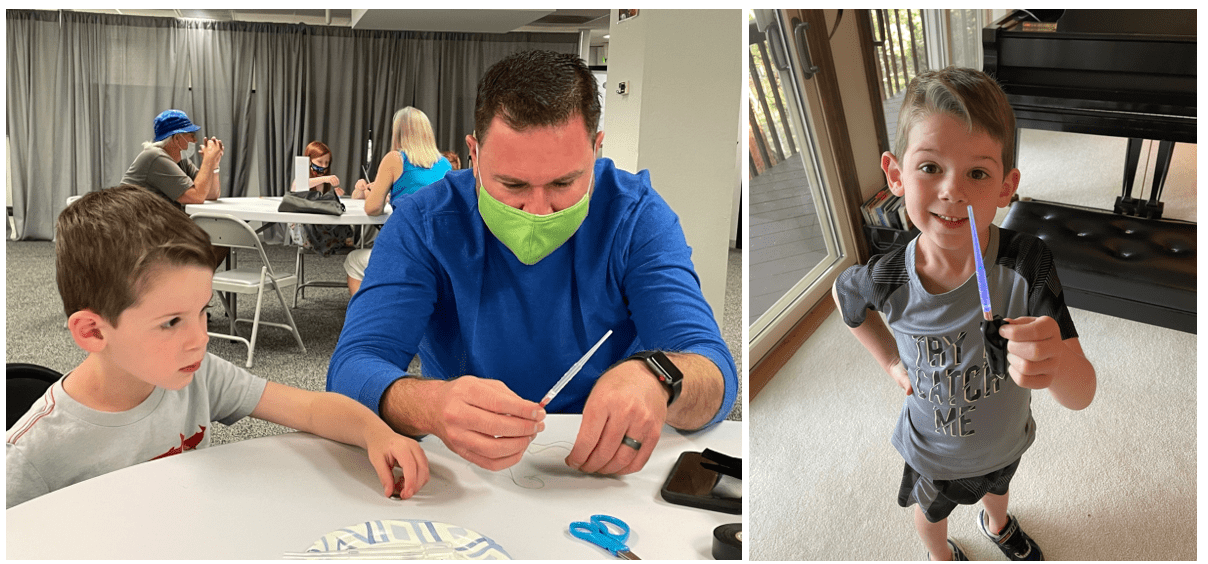
I was able to celebrate on Saturday by taking my son David and grandson Davis, visiting from Atlanta, to the Space Discovery Center in Colorado Springs, where we built a “lightsaber.” I say, “we” – Davis says, “Look what I built…and Daddy helped.” Actually, it may not look like much, but it was very much an adult project. Davis “helped” by cutting the electrical tape and staying out of the way.

Grandson Davis (left) watches our son David try to wire up a lightsaber

Maybe that’s the way effective ministry happens. It’s God’s work, and he allows us to “help.”

I am the vine; you are the branches. If you remain in me and I in you, you will bear much fruit; apart from me you can do nothing. (John 15.5, NIV)

I pray that out of his glorious riches he may strengthen you with power through his Spirit in your inner being, so that Christ may dwell in your hearts through faith. And I pray that you, being rooted and established in love, may have power, together with all the Lord’s holy people, to grasp how wide and long and high and deep is the love of Christ, and to know this love that surpasses knowledge—that you may be filled to the measure of all the fullness of God. Now to him who is able to do immeasurably more than all we ask or imagine, according to his power that is at work within us. (Ephesians 3.16 – 20, NIV, emphasis mine)

Truly, may (God’s) force be with you!

thoughts about life, leadership, and discipleship