Thoughts on the Election

How do you feel about the ongoing saga of the election? As of this writing, we don’t have a declared winner. My son Mark reminded me that in 2000, the winner was not declared until December 13, and that was with only one state in doubt. If we do have a declared winner by the time you read this, you still might find these thoughts helpful.

I know most Americans, including believers, are concerned about the outcome, hoping that “their” side wins. All year, as far back as January, I’ve written that there are committed Jesus followers on all sides. In the last week approaching the election, I saw these three posts:

  • Ed Czyeweski, a Christian author who has written books I have found helpful, wrote this blog on why Christians should NOT vote for Trump.
  • Two friends sent me a link to this sermon by Gary Hamrick of Cornerstone Chapel in Leesburg, Virginia. It’s a well-articulated, one-hour explanation on why Christians should vote for Trump.
  • John Piper, the well-known author and Bible teacher, wrote an essay on why he couldn’t vote for either Trump or Biden. (If you don’t have time to listen to Gary Hamrick’s sermon, you can read Wayne Grudem’s response to John Piper on why he voted for Trump.)

No matter how you voted, you’re in good company, and there are good people who voted differently from you.

Wesley’s rules for voting, that I published early in October, still apply. 

  • Vote for the person you judge most worthy
  • Speak no evil of the person you voted against
  • Take care your spirits are not sharpened against those that voted on the other side

John 13.34, 35 also applies:

A new command I give you: Love one another. As I have loved you, so you must love one another. By this everyone will know that you are my disciples, if you love one another. (NIV)

And, finally, we need all remember who is in charge:

Everyone must submit to governing authorities. For all authority comes from God, and those in positions of authority have been placed there by God. (Romans 13.1, NLT)

The king’s heart is a stream of water in the hand of the LORD;
he turns it wherever he will. (Proverbs 21.1, ESV)

The Power of Little Things

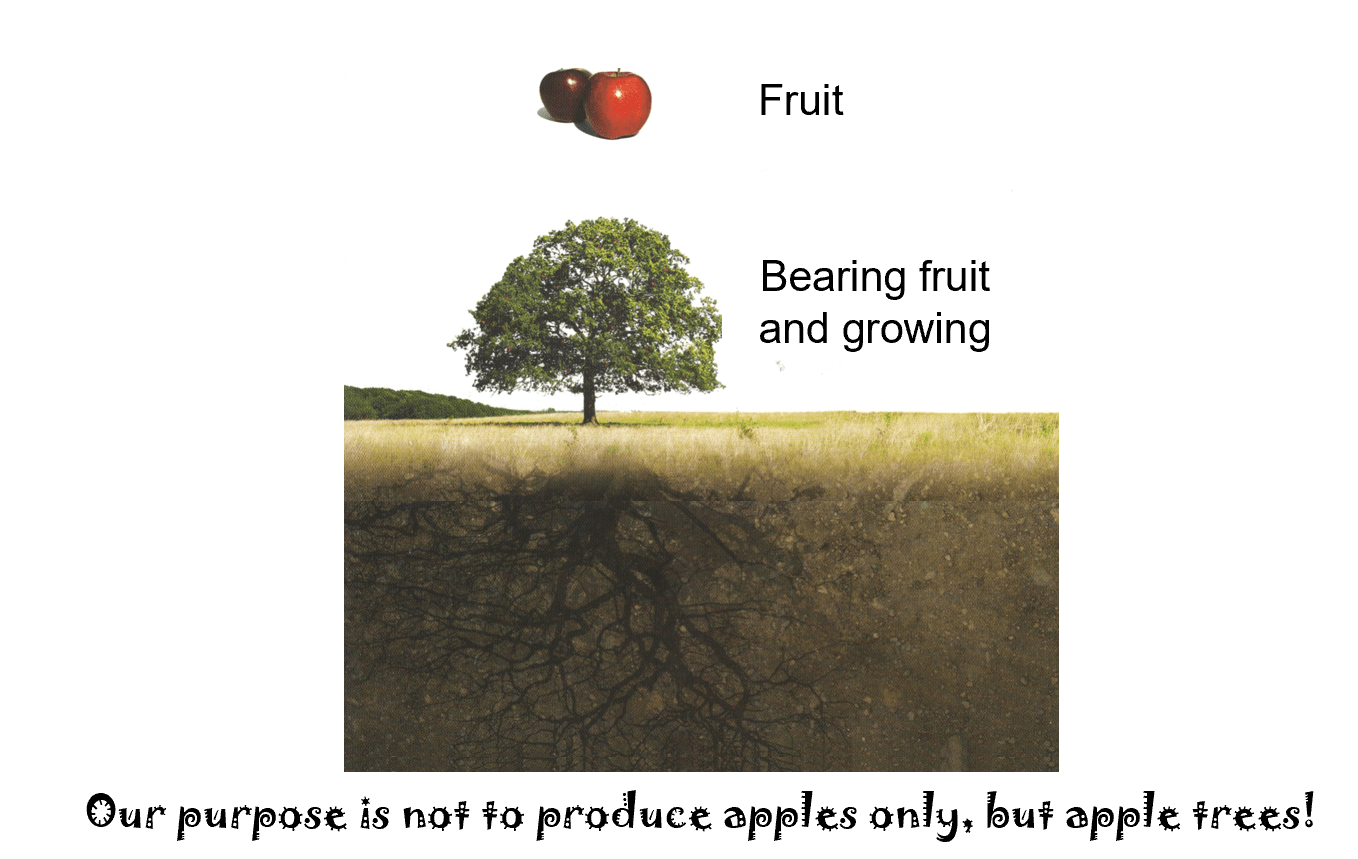
Yesterday, we thought about fruit–the fact that God is looking for fruit and that fruit includes justice and righteousness:

For the vineyard of the LORD of hosts
is the house of Israel,
and the men of Judah
are his pleasant planting;
and he looked for justice,
but behold, bloodshed;
for righteousness,
but behold, an outcry!
 (Isaiah 5.7, ESV)

Mark Greene, in Fruitfulness on the Frontline, suggests six ways to be fruitful, and I’ve written about a few of these before. But I’ve never written about Molding Culture, the topic on which I had to preach recently! (You can see the sermon here if you like – it begins about 26 minutes into the October 25 service.) When I reread Mark’s chapter on the topic, the first example had to do with tablecloths! Here’s the story:

Take, for example, a primary school in an urban regeneration area. Lots of the kids are on free school dinners. Many of them have never experienced what it feels like to sit down for a family meal. Now their canteen is a little drab and rather noisy, and the kid zing in and out like Formula One cars refueling in the pits. It’s the way things are done. But Rachel, the assistant head, wanted to teach them that meals are special, for conversation, not just for food, and she wanted to make them feel special. So the school bought tablecloths for all the tables. The change has been remarkable. The tablecloths absorb some of the clatter…and make the atmosphere calmer, more conducive to chatting. But more significantly, the presence of tablecloths instantly communicated that eating together is special and that kids are, too. In the end, the tablecloths enhanced the quality of relationships, the quality of love, between pupils, and between pupils and teachers. -Fruitfulness on the Frontline, pages 120 – 121.

Tablecloths! A little thing that I certainly never would have thought of. Sometimes we don’t do something because we think we can’t do anything big enough to make a difference. But more often than not, God uses small actions. It’s even how Jesus describes the Kingdom:

Jesus taught them this parable: “How can I describe God’s kingdom realm? Let me illustrate it this way. It is like the smallest of seeds that you would plant in a garden. And when it grows, it becomes a huge tree, with so many spreading branches that various birds make nests there.” Jesus taught them another parable: “How can I describe God’s kingdom realm? Let me give you this illustration: It is like something as small as yeast that a woman kneads into a large amount of dough. It works unseen until it permeates the entire batch and rises high.” (Luke 13.18 – 21, Passion Translation)

Have you seen this domino demonstration by Stephen Morris, illustrating a 1983 physics paper that said that a domino can knock over another domino that is 1.5 times bigger? It’s worth a look, only one minute. Nothing illustrates the power of little things better:

Domino Chain Reaction: (click the picture)

Does anyone dare despise this day of small beginnings? (Zechariah 4.10, MSG)

“We have here only five loaves of bread and two fish,” they answered. “Bring them here to me,” [Jesus] said. (Matt. 14.17, 18)

It’s about Fruit

Yesterday, we noticed that right after Jesus’ call to repentance (“change your mind and amend your ways”), he told this story:

Then Jesus told them this parable: “There was a man who planted a fig tree in his orchard. But when he came to gather fruit from his tree he found none, for it was barren and had no fruit. So he said to his gardener, ‘For the last three years I’ve come to gather figs from my tree but it remains fruitless. What a waste! Go ahead and cut it down!’ “But the gardener said, ‘Sir, we should leave it one more year. Let me fertilize and cultivate it, then let’s see if it will produce fruit. If it doesn’t bear fruit by next year, we’ll cut it down.’” (Luke 13.6 – 9, The Passion Translation)

If the fig tree represents God’s people (the nation Israel in this context), what fruit was he looking for? Isaiah is clear:

For the vineyard of the LORD of hosts
is the house of Israel,
and the men of Judah
are his pleasant planting;
and he looked for justice,
but behold, bloodshed;
for righteousness,
but behold, an outcry!
(Isaiah 5.7, ESV)

The fruit of justice and righteousness: two of the 6Ms of fruitfulness we have written about before. (These come from Mark Greene’s book Fruitfulness on the Frontline.)

  • Model godly character (“righteousness”)
  • Make good work
  • Minister grace and love
  • Mold culture
  • be a Mouthpiece for truth and justice
  • be a Messenger of the gospel

Tomorrow I’ll share a bit about the importance of little things in molding culture – one of the 6Ms. For today, let’s pray for righteousness and justice…in our country, in the aftermath of the election, and in our lives – it’s the fruit God is seeking.

Manifest your Kingdom on earth. (Luke 11.2, The Passion Translation)

For the kingdom of God is not a matter of eating and drinking but of righteousness and peace and joy in the Holy Spirit. (Romans 14.17, ESV)

And he came to Nazareth, where he had been brought up. And as was his custom, he went to the synagogue on the Sabbath day, and he stood up to read. And the scroll of the prophet Isaiah was given to him. He unrolled the scroll and found the place where it was written, “The Spirit of the Lord is upon me, because he has anointed me to proclaim good news to the poor. He has sent me to proclaim liberty to the captives and recovering of sight to the blind, to set at liberty those who are oppressed, to proclaim the year of the Lord’s favor.” (Luke 4.16 – 19, ESV)

As the Father has sent me, even so I am sending you.” (John 20.21, ESV)

Repentance: a theme?

I’ve written recently about repentance. It’s not that I want to – it just keeps coming up in my readings. Back on October 1, we focused on the fact that Jesus preaches repentance to his people, us, not the people “out there.” Then on October 21, we considered that repentance is the only appropriate response to preaching. Today, it’s more of the same:

Some of those present informed Jesus that Pilate had slaughtered some Galilean Jews while they were offering sacrifices at the temple, mixing their blood with the sacrifices they were offering. Jesus turned and asked the crowd, “Do you believe that the slaughtered Galileans were the worst sinners of all the Galileans? No, they weren’t! So listen to me. Unless you all repent, you will perish as they did. Or what about the eighteen who perished when the tower of Siloam fell upon them? Do you really think that they were more guilty than all of the others in Jerusalem? No, they weren’t. But unless you repent, you will all eternally perish, just as they did.” (Luke 13.1 – 5, The Passion Translation)

The first thing that struck me is that Jesus did not condemn Pilate for a particularly heinous and gruesome act. Neither did he condemn the construction industry for the collapse of the tower of Siloam.

Instead, he focused on everyone’s need to repent, which The Passion Translation footnote defines nicely as:

Change your mind and amend your ways.

Amend your ways to do what? Bear fruit! Look at the very next paragraph:

Then Jesus told them this parable: “There was a man who planted a fig tree in his orchard. But when he came to gather fruit from his tree he found none, for it was barren and had no fruit. So he said to his gardener, ‘For the last three years I’ve come to gather figs from my tree but it remains fruitless. What a waste! Go ahead and cut it down!’ “But the gardener said, ‘Sir, we should leave it one more year. Let me fertilize and cultivate it, then let’s see if it will produce fruit. If it doesn’t bear fruit by next year, we’ll cut it down.’” (Luke 13.6 – 9, The Passion Translation)

It’s about fruit, and I’ll have more to say about that tomorrow.

By this my Father is glorified, that you bear much fruit and so prove to be my disciples…You did not choose me, but I chose you and appointed you that you should go and bear fruit… (John 15.8, 16, ESV)

Silence

This is the last of our meditations on my friend Randy Raysbrook’s informal psalm of hope. Thanks Randy.

I say nothing.
Lord, you say, “That is a good start.”

Scriptures are clear that often we would do better being silent than jabbering away.

Be still, and know that I am God. I will be exalted among the nations, I will be exalted in the earth! (Psalm 46.10, ESV)

And now, finally, GOD answered Job from the eye of a violent storm. He said: “Why do you confuse the issue? Why do you talk without knowing what you’re talking about?” (Job 38.1, 2, MSG)

Be not rash with your mouth, nor let your heart be hasty to utter a word before God, for God is in heaven and you are on earth. Therefore let your words be few. (Ecclesiastes 5.2, ESV)

Whose Strength?

Continuing our meditations on my friend Randy Raysbrook’s “psalm:”

I say, “If I am strong enough, I can achieve great things.”
Lord, you say, “Really?”

Line 1 sounds good. We’re supposed to be strong.

”Be strong in the Lord…” (Ephesians 6.10)
“Train yourself for godliness.” (1 Timothy 4.7)

But it’s not my strength, it’s his:

”Be strong in the Lord and the power of his might.” (Ephesians 6.10)
“I can do all things through Christ who strengthens me.” (Philippians 4.13)

And even when I’m strong, I don’t achieve great things. We achieve great things together: I, the Lord, with the community. Football is a good metaphor here. Americans like their heroes, the individual stars, which, in football, is usually the quarterback. But the quarterback, no matter how good he is, by himself, is useless. He doesn’t block for himself. He doesn’t throw the passes to himself. He has to have a very good team around him to succeed, including the coaches who make everything work well together.

Clemson University won its game yesterday without Heisman Trophy candidate Trevor Lawrence who was diagnosed with COVID last week. Clemson won not only because the backup quarterback is talented in his own right but also because of the whole team. The rest of the offense. The defense. Trevor doesn’t achieve great things. The team does.

Now to him who is able to do far more abundantly than all that we ask or think, according to the power at work within us… (Ephesians 3.20, ESV)

Not by might, nor by power, but by my Spirit, says the LORD of hosts. (Zechariah 4.6, ESV)

He told me, My grace is enough; it’s all you need. My strength comes into its own in your weakness… (2 Corinthians 12.9, MSG)

Seeing God in All Things

We’ve been meditating on selected phrases from my friend Randy Raysbrook’s Psalm of Hope:

I love this one:

I say, “Lord, I can’t always see you.”
You say, “Where have you been looking.”

Ignatius of Loyola, among many others, taught the importance of experiencing God’s presence “in all things.” The concept is summarized nicely by the Creighton University School of Pharmacy and Health Professions (speaking of experiencing God’s presence in all things!):

Ignatius of Loyola taught others to experience life attuned to God’s activity in everyday circumstances. Finding God in all things is an invitation to encounter God’s presence in each moment, to become aware of God’s beauty in everything and to notice God’s action in all the events of our lives through an ongoing process of personal discernment. 

As Randy writes, “Where have you been looking?”

7  Is there anyplace I can go to avoid your Spirit? to be out of your sight?
8  If I climb to the sky, you’re there! If I go underground, you’re there!
9  If I flew on morning’s wings to the far western horizon,
10  You’d find me in a minute— you’re already there waiting!
11  Then I said to myself, “Oh, he even sees me in the dark! At night I’m immersed in the light!” (Psalm 139.7 – 11, MSG)

In him we live and move and have our being. (Acts 17.28, ESV)

Discipline?

Yesterday, I shared my friend Randy Raysbrook’s “Psalm of Hope:”

Today, I want to meditate on these phrases:

I say, “If I am disciplined, things will get better.”

Lord, you say, “Who told you that?”

I’m all for discipline: after all, self-control is a fruit of the Spirit (Galatians 5.22, 23), and “God has given us a spirit of power, love, and self-discipline.” (2 Timothy 1.7) But discipline is not all there is. Love precedes it on both lists, and love often mitigates against discipline.

For example, on Monday I talked with one of my mentors about my lack of discipline in the mornings. I like to have my prayer time and exercise early, but often I piddle away the time allotted for prayer reading news, checking email, etc. I need discipline, right? So Tuesday, I shut off the WiFi on my iPad so I wouldn’t be distracted and had a good prayer time.

Then came Wednesday and Thursday. Wednesday started with a last-second, out-of-my-control change to a project I had already sent to a mailing service on the east coast, two hours ahead of me. No choice but to attack that first thing. Thursday, my son David in Atlanta had to close the pre-school he manages because of widespread weather damage and power outages. So we were on the phone with him and his boys first thing. June reminds me, “People are a good use of time.”

So in both cases, the “discipline” I had decided to do in advance had to give way to serving people in real life. Randy’s observation is correct: there are no guarantees that “If I am disciplined, things will get better.” As I’ve observed before, Jesus did not seem to operate on a disciplined schedule. He always had time for interruptions.

As Jesus approached Jericho, a blind man was sitting by the roadside begging…Jesus stopped and ordered the man to be brought to him… (Luke 18.35, 40, NIV)

When Jesus reached the spot, he looked up and said to him, “Zacchaeus, come down immediately. I must stay at your house today.” (Luke 19.5, NIV)

Hope

My friend and Navigator shepherd, Randy Raysbrook, wrote what he called an “informal Psalm.” It’s too good not to share. I reproduce it here with his permission and reserve the right to meditate on parts of it over the next few days.

Be still and know that I am God. Psalm 46.10, NKJV

thoughts about life, leadership, and discipleship