People are different!

One fun thing about the Olympics is the diversity among the athletes, from the tiny gymnasts to the basketball players and shot-putters. You expect Ryan Crouser, winner of the shot put to be big, and he is: 6 feet 7 inches, 320 pounds.

Ryan Crouser, Olympic Shot Put Champion

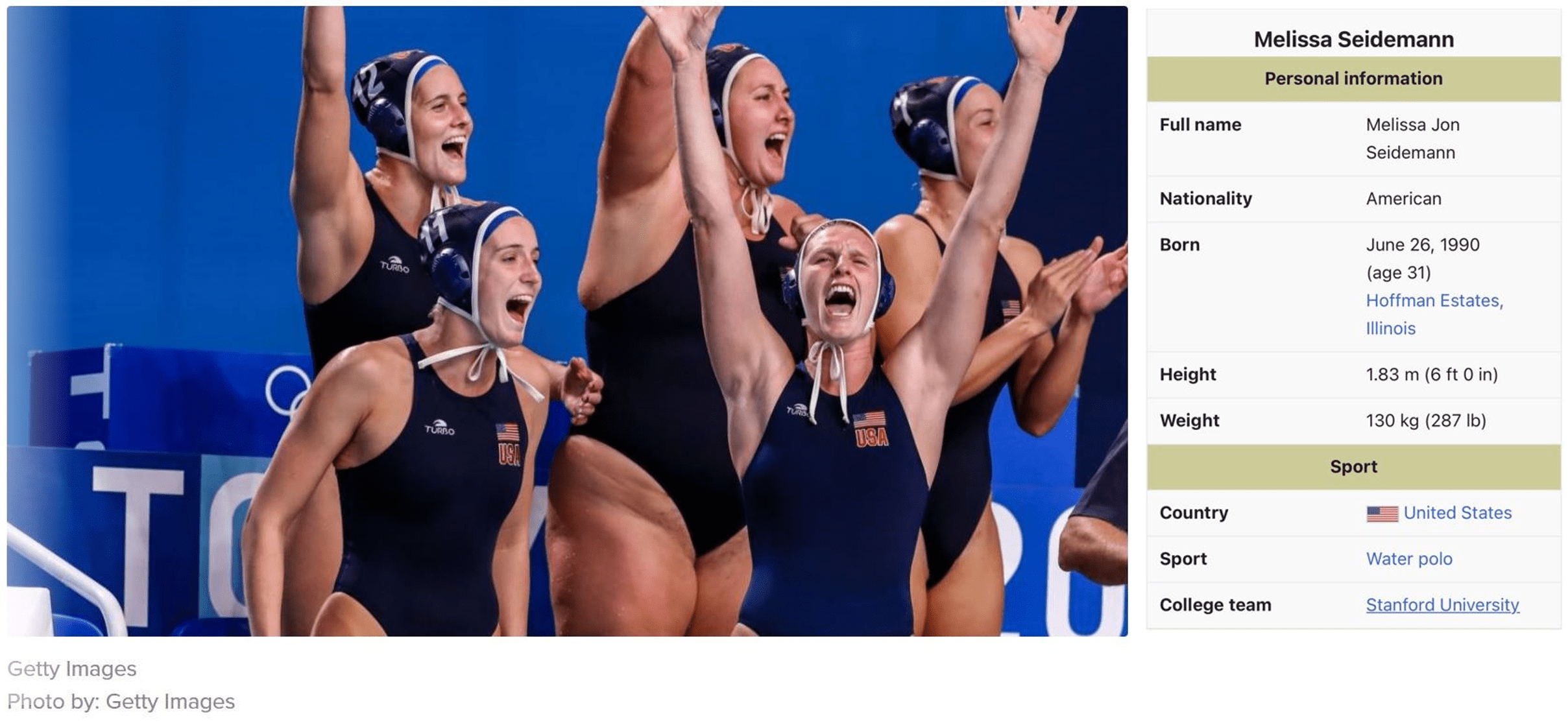
On the other hand, you expect members of the women’s water polo team to be lean. Did you see Melissa Seidemann? She’s third from the left in this photo.

Part of the US Women’s Water Polo team

Melissa is 6 feet tall and weighs, wait for it, 287 pounds. And she’s not the goalkeeper. She’s a defender, and very good at her craft. She won the NCAA championship with Stanford in 2011 and three Olympic gold medals. She is frequently among the team’s top goal scorers. And she’s, shall we say, a bit heavy. So what? 

We’re all different, and we’re all responsible to do the best we can with what we have in the arena where God has placed us.

He creates each of us by Christ Jesus to join him in the work he does, the good work he has gotten ready for us to do, work we had better be doing. (Ephesians 2.10, MSG) 

Now there are varieties of gifts, but the same Spirit; and there are varieties of service, but the same Lord; and there are varieties of activities, but it is the same God who empowers them all in everyone. To each is given the manifestation of the Spirit for the common good. (1 Corinthians 12.4 – 7, ESV)

“I don’t know her…”

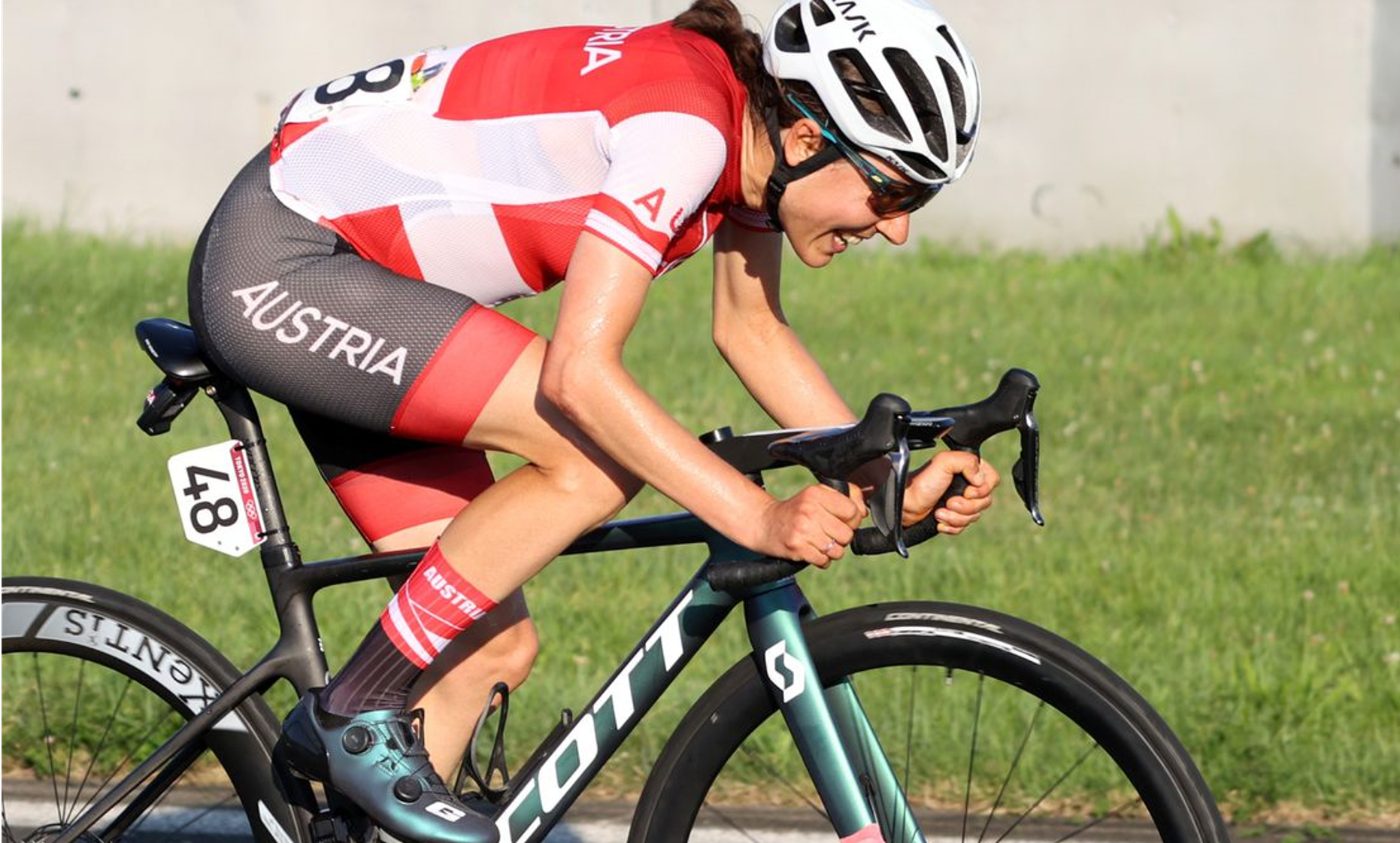
Still thinking about the Olympics, I always wondered what would happen if a cyclist just took off without surrounding oneself with a team in the peloton (the large group of cyclists riding together in a road race). Well, we found out when Austrian Anna Kiesenhofer, an unknown, took off from the start and never looked back.

Austrian Cyclist Anna Kiesenhofer

TOKYO, July 25 (Reuters) – Austrian Anna Kiesenhofer caused one of the biggest shocks in Olympic road racing history with an audacious solo victory in the women’s race as a quartet of Dutch champions paid for an apparent communications meltdown on Sunday.

The 30-year-old Kiesenhofer was allowed to build up a lead of around 10 minutes in a five-rider group that escaped right at the start of the 137km route into the hills west of Tokyo...

She held firm to claim a completely unexpected gold medal in three hours 52 minutes, one minute and 15 seconds, clear of Dutch rider Annemiek Van Vleuten who was celebrating like she had won the race as she crossed the line with arms held aloft.

“I thought I was [number] one,” Van Vleuten was heard saying to her team masseur Ruud Ziljmans on Dutch TV. “Ruud, have I got that wrong?”

“I don’t think anyone wrote her down. I don’t know her. How much can you do wrong, if you don’t know someone?” she said of the Austrian’s surprise victory.

“How much can you do wrong if you don’t know someone?” Sometimes the “elite” miss it. The elite certainly missed Jesus.

Now Philip was from Bethsaida, the city of Andrew and Peter. Philip found Nathanael and said to him, “We have found him of whom Moses in the Law and also the prophets wrote, Jesus of Nazareth, the son of  Joseph.” Nathanael said to him, “Can anything good come out of Nazareth?” Philip said to him, “Come and see.” (John 1.44 – 46, ESV)

The Pharisees answered them, “Have you also been deceived? Have any of the authorities or the Pharisees believed in him? But this crowd that does not know the law is accursed.” Nicodemus, who had gone to him before, and who was one of them, said to them, “Does our law judge a man without first giving him a hearing and learning what he does?” They replied, “Are you from Galilee too? Search and see that no prophet arises from Galilee.” (John 7.47 – 52, ESV)

And take note of this: There are some who are despised and viewed as the least important now, but will one day be placed at the head of the line. And there are others who are viewed as ‘elite’ today who will become least important then. (Luke 13.30, TPT)

Faster, Higher, Stronger

I’m aware that the Olympics were not as popular this year, but we watched a good bit in the evenings, and there are always lessons to be learned. Let’s explore a few of them over the next few days.

One thing that jumped out at me was the Olympic motto:

Faster, higher, stronger

I didn’t know this motto had religious roots:

The traditional Olympic motto is…”faster, higher, stronger”. It was proposed by Pierre de Coubertin upon the creation of the International Olympic Committee. Coubertin borrowed it from his friend Henri Didon, a Dominican priest who was an athletics enthusiast. Coubertin said “These three words represent a programme of moral beauty. The aesthetics of sport are intangible.” The motto was introduced in 1924 at the Olympic Games in Paris. – Wikipedia

I also missed the fact that they added “together” for this year’s games: faster, higher, stronger – together. But that’s not what I want to talk about today. What amazes me is the degree to which “faster, higher, stronger” is being achieved. For example,

  • Two men broke the existing world record for the 400-meter hurdles, running 1.7 seconds faster than Eric Liddell’s 1924 Olympics world record of 47.6 seconds for the 400 meters WITHOUT hurdles. 
  • I remember vividly the pole vault champion when I was growing up – Bob Richards, who went on to become a minister and motivational speaker. Bob did the pole vault around 15 feet 6 inches. This year, the American gold medal female did 16 feet, and the winning man did 19 feet, 9 inches, 4 feet higher than Bob Richards.
  • The leading high jumper of my day was John Thomas, using the “straddle” technique. His personal best was 7 feet, 3.75 inches. Dick Fosbury introduced the “Fosbury Flop” and won the 1968 Olympics with a jump of 7 feet, 4 inches. Today, everyone uses the Fosbury Flop, and this year’s winners jumped more than 7 feet 9 inches. By the way, if you didn’t see the end of the high jump competition, it’s worth the five minutes. An extraordinary display of both athletic ability and sportsmanship.

Faster, higher, stronger. We can never rest on past accomplishments whether we are trying to be faster, higher, or stronger than everyone else, or just faster, higher, stronger than we were yesterday.

Truly, truly, I say to you, whoever believes in me will also do the works that I do; and greater works than these will he do, because I am going to the Father. (John 14.12, ESV)

Brothers, I do not consider that I have made it my own. But one thing I do: forgetting what lies behind and straining forward to what lies ahead, I press on toward the goal for the prize of the upward call of God in Christ Jesus. (Philippians 3.13, 14, ESV)

A Picture of the Kingdom

Yesterday I wrote about attending two memorial services in one day – some similarities, many differences. Today, I want to go more in-depth on Willie Hill’s service: attended by all kinds of people – black and white, young and old, believers and not (most likely).

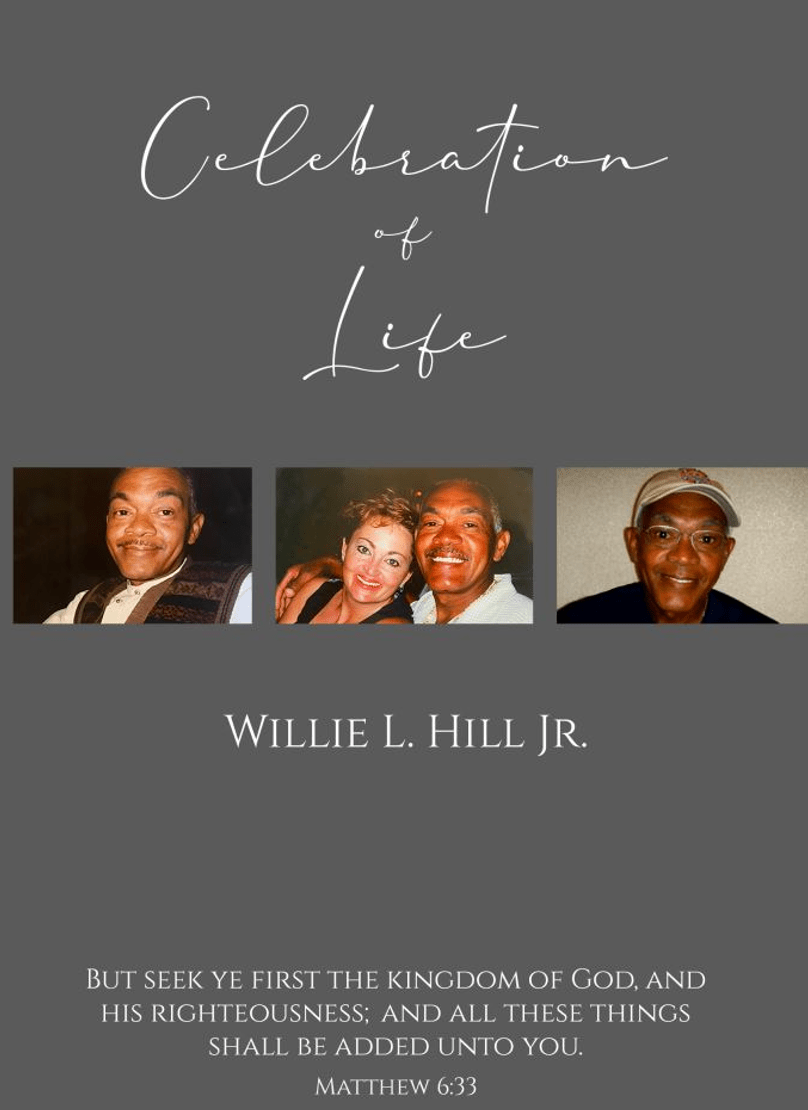
The front cover of the bulletin for Willie’s memorial: “Seek ye first the Kingdom of God…”

As I said, it was my second memorial service of the day, and in this one, I had no responsibilities (I thought!), so I drove the hour and fifteen minutes, arriving exactly at the 4p start time, intending to slip in and sit in the back. The service hadn’t started, and as I walked in Willie’s widow, Mary, rushed to the back of the auditorium, wrapped me in a big hug, thanked me for coming, and dragged me to the front: “You will sit here with me, and at the end of the service, we will be asking people to come forward to be prayed for. You will be up front with the other pastors to pray for people.” OK…

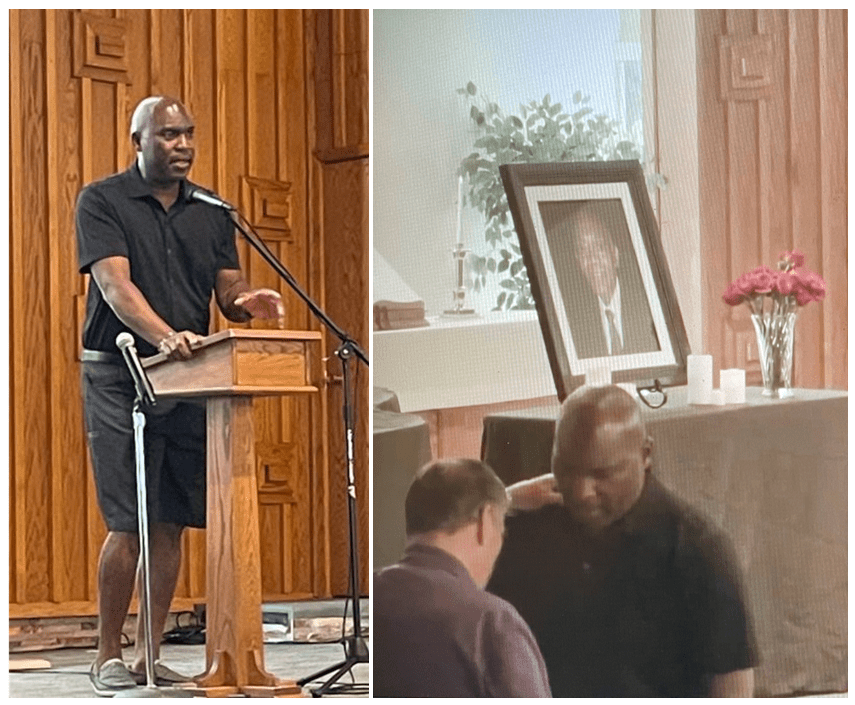
I always wear a coat and tie to a memorial service, but this one was Saturday afternoon in the summer with barbecue to follow so I asked Mary in advance what the dress was. “Summer casual.” And sure enough, it was. Here is one of the pastors giving a eulogy and after, he and I praying for each other.

Pastor Dwayne Johnson in “summer casual.” We pray for each other after.

The service was tightly organized (Mary is a detail person) but carried out with spontaneity. Lots of laughter and tears, live presentations and videos. In the main eulogy, read by Roger Smith on a video, Mary had included material from my end-of-year ministry update, December 2020. She said Willie found these sentences especially meaningful:

Church people think about how to get people into the church; Kingdom people think about how to get the church into the world. Church people worry that the world might change the church; Kingdom people work to see the church change the world. – Mutua Mahiani, International President of The Navigators, quoting Howard Snyder’s Liberating the Church.

Willie was a Kingdom person in every sense of the word. And his celebration of life with the diversity of people and styles was a picture of that Kingdom. I think that’s what energized me about being there and participating.

One more thing: I write about racial reconciliation and racial justice from time to time, most recently about a week ago. But it’s one thing to write about it and another to be in the middle of a mixed-race event. I came away with a new insight: we need each other.

Now when He had taken the scroll, the four living creatures and the twenty-four elders fell down before the Lamb, each having a harp, and golden bowls full of incense, which are the prayers of the saints. And they sang a new song, saying: “You are worthy to take the scroll, And to open its seals; For You were slain, And have redeemed us to God by Your blood Out of every tribe and tongue and people and nation, and have made us kings and priests to our God; and we shall reign on the earth.” (Revelation 5.8 – 10, NKJV)

Two Good Men

Yesterday I talked about playing service for a memorial last Saturday, August 7. What I didn’t say is that I attended two memorial services that day. Both were memorials of good men, believers. Both services honored God and the men. But the men and the services had commonalities and differences, and there are lessons to be learned. God is a God of variety.

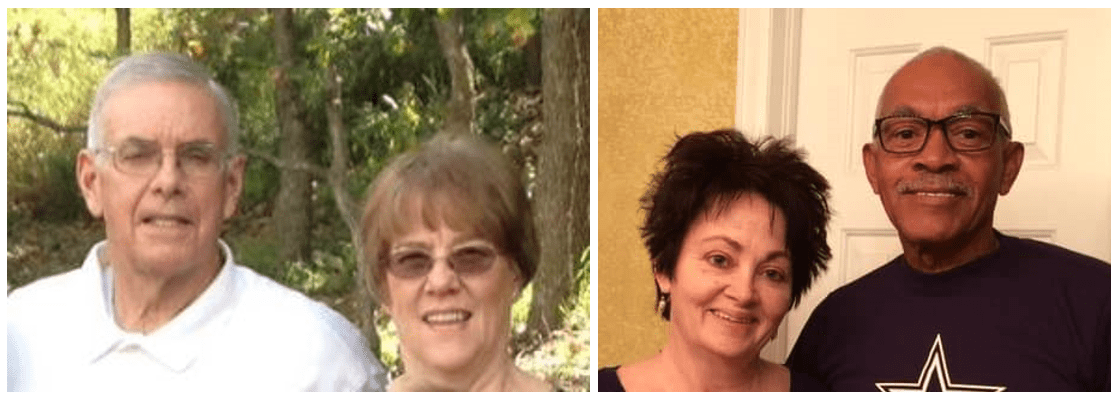
Here are the two couples, now two widows: Mike (deceased) and Cindy Jackson and Willie (deceased) and Mary Hill:

Mike and Cindy / Mary and Willie

Here are some observations:

  • Mike was a retired colonel in the US Air Force; Willie was a retired postal worker.
  • Mike served God mainly through his work, by defending his country as a missile maintenance officer and taking care of his people. Willie’s work was never mentioned: he and Mary served in direct ministry. Recalling the 6 Ms, Mike “made good work.” Willie was a “mouthpiece for truth and justice” and a “messenger of the gospel” to children and adults. Both “ministered grace and love” and “molded cultures” around them. Both “modeled godly character.”
  • Mike and Cindy had been married for 41 years and had three children. Willie and Mary were married 24 years and each had been married before. There were more children and step-children than I could count, but, nearly as I could tell, it was one big happy family.
  • Mike had dementia the last two or three years of his life so his passing in December 2020 was a blessing. Willie had a severe bout of lung disease back in 2017, but he pulled out of it. He and Mary were thankful for an additional four years before he passed in April 2021. They would say, “Willie received his complete healing, just not in this life.”
  • Except for family, Mike’s service was attended by older white people. Besides the officiating minister there were three family speakers, one Air Force colleague, and one video. I will write more on Willie’s service tomorrow, but besides the officiating minister there were several other ministers, black and white, lay speakers, and multiple videos, and the attendees were black and white, young and old.
  • Both services closed with a clear gospel presentation with both ministers using John 3.16 and focusing on God’s love.

When I first started writing this blog, I thought the two men and the two services were completely different. That turned out not to be true: there were some commonalities. But as powerful as Mike’s service was, Willie’s had a more profound effect on me. I’ll say more about that tomorrow.

Precious in the sight of the LORD is the death of his saints. (Psalm 116.15, ESV)

“O death, where is your victory? O death, where is your sting?” The sting of death is sin, and the power of sin is the law. But thanks be to God, who gives us the victory through our Lord Jesus Christ. (1 Corinthians 15.55 – 57, ESV)

For in Christ Jesus you are all sons of God, through faith. For as many of you as were baptized into Christ have put on Christ. There is neither Jew nor Greek, there is neither slave nor free, there is no male and female, for you are all one in Christ Jesus. (Galatians 3.26 – 28, ESV)

Progress in what matters

I wrote last week about some small amount of progress in my golf game, but, of course, the real subject is progress in the Christian life.

I’m pleased to report experiencing God’s grace in a situation that years ago I wouldn’t have taken so well. I think I am finally growing in flexibility. Maybe it’s also holy indifference.

This past Saturday I was to play piano – prelude and postlude – for a friend’s memorial service scheduled to start at 10a. When I arrived as directed for a 9:15a soundcheck, there was no sound man and no piano! I was told the sound man was “on his way,” and that we would be using a keyboard. At 9:50a, the sound man arrived and said there was no way they could put a piano out there. I said, “I understand we can’t move a piano, but surely we can set up a keyboard.”

Apparently having a piano (or keyboard) was not a value for the pastor or the sound man. Long story short, I helped set up the keyboard, and we were ready to go right at 10:00 (for a 10:00 service!). We did the “soundcheck” as I was playing a quick prelude.

Anyway, we got through it, and I am pleased to have grown in flexibility over the past decades. June said, “Musicians must be flexible.” It’s growth in the fruit of the Spirit, specifically, peace, patience, and gentleness. I didn’t flap internally or externally. The widow wrote to say, “You were so patient and grace-giving about the piano not being there.” For all that I’m grateful.

For this very reason, make every effort to add to your faith goodness; and to goodness, knowledge; and to knowledge, self-control; and to self-control, perseverance; and to perseverance, godliness; and to godliness, mutual affection; and to mutual affection, love. For if you possess these qualities in increasing measure, they will keep you from being ineffective and unproductive in your knowledge of our Lord Jesus Christ. (2 Peter 1.5 – 8, NIV)

What does God require?

There’s an interesting exchange in the early part of Ezra. 42,000 Jews have returned from Babylon to rebuild the temple and some of the locals want to help:

Now when the adversaries of Judah and Benjamin heard that the returned exiles were building a temple to the LORD, the God of Israel, they approached Zerubbabel and the heads of fathers’ houses and said to them, “Let us build with you, for we worship your God as you do, and we have been sacrificing to him ever since the days of Esarhaddon king of Assyria who brought us here.” But Zerubbabel, Jeshua, and the rest of the heads of fathers’ houses in Israel said to them, “You have nothing to do with us in building a house to our God; but we alone will build to the LORD, the God of Israel, as King Cyrus the king of Persia has commanded us.” (Ezra 4.1 – 3, ESV)

At first glance, the inclusive bias that we have today would say, “Why not let them rebuild with you?”

But let’s see what actually happened when they say, “We have been sacrificing to him ever since the days of the king of Assyria who brought us here.”

And the king of Assyria brought people from Babylon, Cuthah, Avva, Hamath, and Sepharvaim, and placed them in the cities of Samaria instead of the people of Israel. And they took possession of Samaria and lived in its cities. And at the beginning of their dwelling there, they did not fear the LORD. Therefore the LORD sent lions among them, which killed some of them. So the king of Assyria was told, “The nations that you have carried away and placed in the cities of Samaria do not know the law of the god of the land. Therefore he has sent lions among them, and behold, they are killing them, because they do not know the law of the god of the land.” Then the king of Assyria commanded, “Send there one of the priests whom you carried away from there, and let him go and dwell there and teach them the law of the god of the land.” So one of the priests whom they had carried away from Samaria came and lived in Bethel and taught them how they should fear the LORD. But every nation still made gods of its own … They also feared the LORD and appointed from among themselves all sorts of people as priests of the high places, who sacrificed for them in the shrines of the high places. So they feared the LORD but also served their own gods… (portions of 2 Kings 17.24 – 33, ESV)

They feared the LORD but also served their own gods…

This was about the people who resettled Samaria but no doubt the situation was the same for those living around Jerusalem.

What’s the great commandment? Love God with ALL your heart… Not “include God among the gods you worship.” That’s something we can all repent of!

What’s the minimum? What does the god of the land require? A sacrifice from time to time? And I can do what I want in between? Keep Sabbath but do what I want the other six days? Go to church on Sunday and tithe 10%? But the rest of my time and money is mine? That’s the way a lot of us live.

We want it quantified, to give God a portion. He wants it all.

What does the LORD require of you but to do justice, and to love kindness, and to walk humbly with your God? (Micah 6.8, ESV)

Is not this the fast that I choose: to loose the bonds of wickedness, to undo the straps of the yoke, to let the oppressed go free, and to break every yoke? Is it not to share your bread with the hungry and bring the homeless poor into your house; when you see the naked, to cover him, and not to hide yourself from your own flesh? (Isaiah 58.6, 7, ESV)

And one of the scribes asked him, “Which commandment is the most important of all?” Jesus answered, “The most important is, ‘Hear, O Israel: The Lord our God, the Lord is one. And you shall love the Lord your God with all your heart and with all your soul and with all your mind and with all your strength.’” (Mark 12.28 – 30, ESV)

Unless You Repent…

What is important about current events? What should our reaction be? Here are a couple of lessons from one of the more difficult vignettes in the gospels:

Some of those present informed Jesus that Pilate had slaughtered some Galilean Jews while they were offering sacrifices at the temple, mixing their blood with the sacrifices they were offering. Jesus turned and asked the crowd, “Do you believe that the slaughtered Galileans were the worst sinners of all the Galileans? No, they weren’t! So listen to me. Unless you all repent, you will perish as they did.” (Luke 13.1 – 3, TPT)

There is so much tied up in this short section, which is recorded only in Luke:

  • The Romans had the power to do whatever they wanted. You can see hints of this in The Chosen. The Roman oppressors were cruel, malicious, and capricious.
  • Jesus refuses to get into it with the Romans or even talk about the Romans. Why did the people tell Jesus about what Pilate did? I believe their intent was to stir him up. After all, won’t the Messiah deliver us from this sort of thing? Jesus doesn’t take the bait nor does he focus on things he can do nothing about.
  • What he does focus on is the underlying belief that misfortune happens to those who are sinners. Jesus does address that. All need to repent.

Unless YOU repent. Not, “I wish Pilate would repent.” We seem to spend a lot of time critiquing the government or the culture. We want our rights. We want others to behave. Jesus challenges his listeners to critique themselves.

Those whom I love, I reprove and discipline, so be zealous and repent. (Revelation 3.19, ESV)

Light?

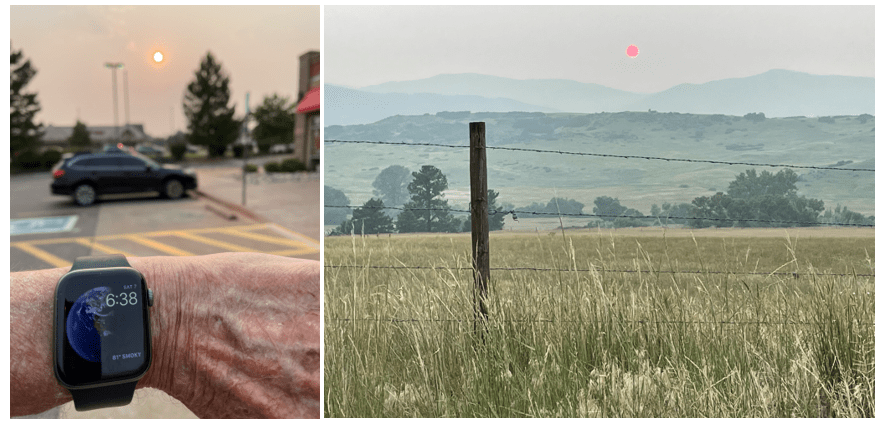
Colorado, known for clear skies most days of the year, is inundated by smoke from the California and Oregon forest fires as I draft this. The Air Quality Index, normally well below 50, was over 150 on August 7. The weather app on my watch used a word I’ve never seen it use before: SMOKY. Here are two pictures of the setting sun, the first is in the Denver area. The second, about half an hour later, was made between Sedalia and Palmer Lake on Colorado 105. The small mountains there are only a few miles away and still nearly invisible.

I guess the lesson is that just because the sun is hard to see doesn’t mean it’s not there. Sometimes pollution that’s not even our fault blocks its light.

In him was life, and the life was the light of men. The light shines in the darkness, and the darkness has not overcome it. There was a man sent from God, whose name was John. He came as a witness, to bear witness about the light, that all might believe through him. He was not the light, but came to bear witness about the light. The true light, which gives light to everyone, was coming into the world. (John 1.4 – 9, ESV)

So Jesus said to them, “The light is among you for a little while longer. Walk while you have the light, lest darkness overtake you. The one who walks in the darkness does not know where he is going. While you have the light, believe in the light, that you may become sons of light.” (John 12.35, 36, ESV)

Reconcilers or Combatants?

Yesterday I reminded us that among the ways we should be “performing” – living out the gospel in real life are the 6 Ms from Fruitfulness on the Frontline:

  • Model godly character
  • Make good work
  • Minister grace and love
  • Mold culture
  • Be a Mouthpiece for truth and justice
  • Be a Messenger of the gospel

Here’s a practical, up-to-date example of at least three of the six: Minister grace and love, Mold culture, and Mouthpiece for truth and justice.

The Apostle Paul is clear:

All this is from God, who through Christ reconciled us to himself and gave us the ministry of reconciliation; that is, in Christ God was reconciling the world to himself, not counting their trespasses against them, and entrusting to us the message of reconciliation. Therefore, we are ambassadors for Christ… (2 Corinthians 5.18 – 20, ESV)

The well-known black preacher Tony Evans has echoed this point loud and clear:

Conflict in terms of race relations boils down to a pivotal question, Pastor Tony Evans of Oak Cliff Bible Fellowship told those gathered at his church on Wednesday, July 21. “Am I a reconciler, or am I a combatant? Am I contributing to what God has done for me, bringing harmony where there was conflict, or am I one who keeps the fire [of division] burning?” he asked. “The more we are engaged … in the ministry of reconciliation, the more God is going to be with us because we were reconciled to Him. Therefore, we are ambassadors for Christ.”Dr. Tony Evans, July 21, 2021

The report of Tony Evans’ sermon appears in a July 27 report from the Baptist Press and is worth the read in its entirety. Among other things, he points up what could be useful from Critical Race Theory (CRT) and distinguishes between Black Lives Matter as a movement (a good thing) and as an organization (a bad thing). Here are some snippets:

CRT is a post-Civil Rights social construct that seeks to demonstrate how unjust laws have served as the embedded foundation and filter through which racist attitudes, behavior, policies and structures have been rooted throughout the fabric of American life and systems even after those laws have changed.

CRT, in and of itself, can be useful in addressing the long-lasting effects of racist laws and cultural norms that continue to exist.

Black Lives Matter must be addressed both as a movement and an organization. The movement says the lives of Black people matter in the same way all of us evangelicals say the lives of the unborn matter. The organization of the same name is unbiblical and actually advocates for the destruction of the Black family.

Dr. Evans then introduces a concept he calls Kingdom Race Theology (KRT):

KRT the reconciled recognition, affirmation and celebration of the divinely created ethnic differences through which God displays His multifaceted glory as His people justly, righteously and responsibly function personally and corporately in unity under the Lordship of Jesus Christ. He pointed to Paul’s admonition to the church in Ephesus for reconciliation among two groups who didn’t get along – Gentiles and Jews. A country’s Olympic athletes may be different, but they compete under the same flag. Another way of putting it is that they compete for the same kingdom.

If you are a believer in Christ, then you are required to be a reconciler. We are not to allow the divisions of society to create divisions in the kingdom. You operate under a different flag now.

All good stuff, well-articulated. All of us in the body of Christ need to be part of the solution.

For in Christ Jesus you are all sons of God, through faith. For as many of you as were baptized into Christ have put on Christ. There is neither Jew nor Greek, there is neither slave nor free, there is no male and female, for you are all one in Christ Jesus. (Galatians 3.26 – 28, ESV)

thoughts about life, leadership, and discipleship