My friend Terry invited me to a gathering where some of his friends shared their testimonies and lessons learned in a life of following Jesus. It’s always uplifting to be around quality people.
The men shared some inspiring thoughts worth passing on, which I will do over the next few days.
The first speaker was Jack.
Jack talked about his own faith journey, having to decide if he was really going to follow Jesus while he was in college. His father noticed his son’s faith, wished he had it, but remained an unbeliever. Finally, 10 months before his dad died, Jack was able to once again encourage his dad to follow Jesus. The conversation went something like this:
Dad: “I’d like to believe, but I’m not 100% sure that Jesus is who he claimed to be.”
Son: “Since when has any of us ever been 100% sure of anything? Besides you always taught me to be decisive! You didn’t get to be a CEO by waiting to be ‘100% sure.’ What does the evidence tell you?”
His father then sifted through the evidence he knew such as fulfilled prophecy. He believed.
Dad: “What a fool I’ve been all these years. The evidence is overwhelming.”
That grabbed me: “Since when has any of us ever been 100% sure of anything?” With Jesus, the evidence is overwhelming if anyone is willing to look at it.
Inasmuch as many have undertaken to compile a narrative of the things that have been accomplished among us, just as those who from the beginning were eyewitnesses and ministers of the word have delivered them to us, it seemed good to me also, having followed all things closely for some time past, to write an orderly account for you, most excellent Theophilus, that you may have certainty concerning the things you have been taught. (Luke 1.1 – 4, ESV)
Now Jesus did many other signs in the presence of the disciples, which are not written in this book; but these are written so that you may believe that Jesus is the Christ, the Son of God, and that by believing you may have life in his name. (John 20.30, 31, ESV)
There is often confusion on this simple concept. After all, “We’re saved by grace, right?” A friend of mine’s extended family members are hard over on this. Anything somebody suggests something they might want to DO as believers is rejected out of hand as “works righteousness.”
He told me about a fellow who is like the people I wrote about:
One of the guys I am discipling is like this. I can’t EVER say anything to him that sounds like obedience without him making an immediate disclaimer like, “I know that if I do ‘_______’ in my ‘flesh’ I will always fail. So I need God’s grace to walk in the Spirit.” … And I want to say, “OK, I get that … I believe what the Bible says about walking in grace by the Holy Spirit just like you do … but can we just DOwhat God tells us to do without the theology lesson each time we read something that sounds like obedience?” Deuteronomy 30:14 (RSV) says, “But the word is very near you; it is in your mouth and in your heart, so that you can do it.”
My friend went on to cite Philippians 2.12 – 13:
Therefore, my beloved, as you have always obeyed, so now, not only as in my presence but much more in my absence, work out your own salvation with fear and trembling, for it is God who works in you, both to will and to work for his good pleasure. (Philippians 2.12, 13, ESV)
He writes:
As you know, Philippians 2.12 – 13 covers both sides of the equation. We have “our work” – obey, work out our salvation, and God has “His work” – He works in us so that we “will” and “work” to please Him. However, God does His work in us without us first asking Him to do it. So, when I choose to obey, the work of grace is already done. Because of this, from the believer’s perspective, obedience is a “one-step” process, not a “two-step”, like my/your friends imply: i.e. (1) I “walk” in the Spirit, and then (2) I “obey.” However, from our friends’ perspective, there is a “thing” called “obedience in the flesh.”
It’s amazing how many excuses (sometimes disguised in theological language) we can come up with to NOT do what God asks us to do. “I can’t do that – it would be works-righteousness. OR “I can’t do that without it being obedience in the flesh.” In the meantime, who is going to take those freshly-baked cinnamon rolls over to our neighbor’s house?
But why do you call Me “Lord, Lord,” and do not do the things which I say? (Luke 6.46, NKJV)
June and I were sharing lunch with old friends last week, and we were discussing our respective visits to Israel. We were privileged to travel there in 2004 while our daughter and husband were teaching at an American school in Herzelia. During our conversation, I shared this story…
While there we did a Sunday afternoon workshop on daily time with God, much like I’ve taught many times and write about here from time to time. It’s a simple plan: take a short section of scripture and…
Read, marking what stands out to you – what God is saying to you in that moment
Reflect, on one of those thoughts, applying it personally and specifically
So I was teaching this to a group from our daughter’s church in Israel. As I was wrapping up with questions and answers, in walked well-known international Bible teachers and authors Stuart and Jill Briscoe. I said something like, “Stuart, it’s nice to meet you all. We’ve been spending the afternoon talking about how we can have daily time with God through the Word and prayer. Would you like to say a little something to close us out?” Stuart and Jill live in Wisconsin, but Stuart is originally from England. In his inimitable British accent he said:
In John 21, Jesus said to Peter, “Feed my lambs…feed my sheep.” Now I used to tend sheep in England. And the way you feed a lamb is to pick it up, put it under your arm, and stick a bottle in its mouth. The way you feed a sheep is to take it out and show it where the pasture is. I think in many of our churches, we have a lot of adult sheep under our arms and we’re trying to stick bottles in their mouths!
Then he looked at me and said, “Are you and I on the same page?” And I replied, “Yes sir.”
It was a good lesson. Why are we bottle-feeding people that should be feeding themselves? 1 John 2 is clear: we should be progressing from infants -> children -> young adults -> parents. Young adults feed themselves; parents feed others.
I am writing to you, little children, because your sins are forgiven for his name’s sake. I am writing to you, fathers, because you know him who is from the beginning. I am writing to you, young men, because you have overcome the evil one. I write to you, children, because you know the Father. I write to you, fathers, because you know him who is from the beginning. I write to you, young men, because you are strong, and the word of God abides in you, and you have overcome the evil one. (1 John 2.12 – 14, ESV, emphasis mine)
As a graduate of Clemson University and a loyal Clemson football fan, I am following the Jacksonville Jaguars of the NFL since Clemson’s star quarterback, Trevor Lawrence, is playing for them. Before last Sunday, the Jags had lost their first five games this season, which I think is more games than Trevor has lost his entire life. (They had also lost their last 15 games last season.) But Sunday, October 17, in London of all places, they won. Here’s some of what ESPN said:
The Jacksonville Jaguars have a championship pedigree at coach and quarterback [former college coach Urban Meyer and Trevor Lawrence]. However it took a software engineer-turned-kicker to finally end the misery of a 20-game losing streak. Matthew Wright’s 53-yard field goal as time expired gave the Jags a 23-20 victory over the Miami Dolphins on Sunday at Tottenham Hotspur Stadium in London.
What’s funny is what they reported next:
“I don’t think anybody on our team ever heard him speak until about 10 minutes ago,” Jags coach Urban Meyer said. Wright, playing just his third game for the Jags (1-5), also nailed a clutch 54-yarder to tie the game at 20 with 3:40 remaining.
Here’s what grabbed me. The hero, the guy who was programming computers just six weeks earlier, said:
Just not a huge talker, just here to do my job. – Matthew Wright, 25-year-old kicker for the Jacksonville Jaguars
Matthew is on to something: less talk, more action.
Do not be quick with your mouth, do not be hasty in your heart to utter anything before God. God is in heaven and you are on earth, so let your words be few. A dream comes when there are many cares, and many words mark the speech of a fool. (Ecclesiastes 5.2, 3, NIV)
My dear brothers and sisters, take note of this: Everyone should be quick to listen, slow to speak… (James 1.19, NIV)
Don’t let anyone look down on you because you are young, but set an example for the believers in speech… (1 Timothy 4.12, NIV)
My friend and faithful blog reader Kathleen Krucoff helped organize a display of members’ art at Monument Community Presbyterian Church this month. We both helped close out the exhibition during yesterday’s Sunday morning service. She opened with a snippet from my blog on spirit-filled art from a couple of years ago:
Who was the first person in the Bible said to be filled with the Spirit? And for what?
The Lord said to Moses, “See, I have called by name Bezalel the son of Uri, son of Hur, of the tribe of Judah, and I have filled him with the Spirit of God, with ability and intelligence, with knowledge and all craftsmanship, to devise artistic designs, to work in gold, silver, and bronze, in cutting stones for setting, and in carving wood, to work in every craft. (Exodus 31.1 – 5, ESV, emphasis mine)
The first person in the Bible filled with the Spirit of God was an artist, called to work on building the tabernacle and teach others to do the same. – Ewellogy, June 9, 2019
As I reflected on that idea in preparing for a dedicatory prayer, I realized that it’s only reasonable that the first spirit-filled person was an artist since the first artist was God himself! On Saturday, we looked at his sunrise.
The heavens declare the glory of God, and the sky above proclaims his handiwork. (Psalm 19.1, ESV)
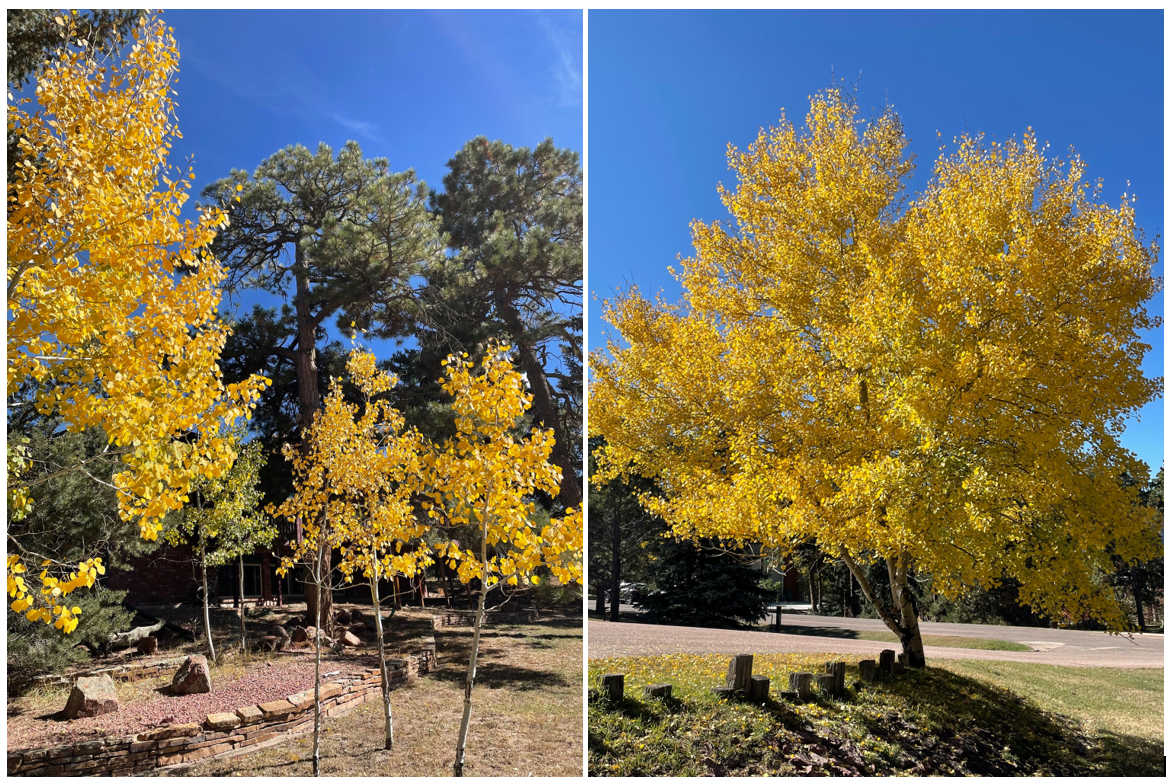
On Sunday, we admired the fall colors, which continue to dazzle. We can’t stop taking pictures of our aspens.
God’s artistic handiwork!
Today, let’s remember that we ourselves are part of his artwork:
We have become his poetry, a re-created people that will fulfill the destiny he has given each of us, for we are joined to Jesus, the Anointed One. Even before we were born, God planned in advance our destiny and the good works we would do to fulfill it! (Ephesians 2.10, TPT, emphasis mine))
The note on “poetry” adds:
The beautiful Greek word used here is translated “poem” or “poetry.” Our lives are the beautiful poetry written by God that will speak forth all that he desires in life.
Continuing with the theme of God’s gifts to us, we weren’t able to drive to the mountains this year to see the aspens, but God was gracious enough to provide scenery right here in the neighborhood. It’s one of the benefits of having to walk the dog several times every day!
He changes times and seasons; he removes kings and sets up kings; he gives wisdom to the wise and knowledge to those who have understanding. (Daniel 2.21, ESV)
Every good gift and every perfect gift is from above, coming down from the Father of lights with whom there is no variation or shadow due to change. (James 1.17, ESV)
But I say to you, Love your enemies and pray for those who persecute you, so that you may be sons of your Father who is in heaven. For he makes his sun rise on the evil and on the good, and sends rain on the just and on the unjust. (Matthew 5.44, 45, ESV)
Sometimes we need to take a break from heavy meditations and just enjoy what God gives us. Earlier this week, we woke up to a most unusual sunrise. June saw it first, and I took a few pictures, but a couple of my neighbors (from NextDoor) did a better job and were kind enough to post:
So that’s a double blessing: God provides the scenery; nice people share it with others.
Here’s one picture I took from my deck. Like the others, no filter. This is the way it looked. Mine has a peek at Pike’s Peak in the background, and my large aspen in the process of changing color.
The heavens declare the glory of God, and the sky above proclaims his handiwork. (Psalm 19.1, ESV)
The other day I read this in Ecclesiastes which says, basically, we can’t figure God out:
There is a vanity that takes place on earth, that there are righteous people to whom it happens according to the deeds of the wicked, and there are wicked people to whom it happens according to the deeds of the righteous. I said that this also is vanity. And I commend joy, for man has nothing better under the sun but to eat and drink and be joyful, for this will go with him in his toil through the days of his life that God has given him under the sun. When I applied my heart to know wisdom, and to see the business that is done on earth, how neither day nor night do one’s eyes see sleep, then I saw all the work of God, that man cannot find out the work that is done under the sun. However much man may toil in seeking, he will not find it out. Even though a wise man claims to know, he cannot find it out. (Ecclesiastes 8.14 – 17, ESV)
Righteous people get sick and die while the wicked seem to prosper. Decide to be joyful no matter what. No one can figure out what God is doing.
Shortly after reading this text, I received a health update from my Navigator friend Roy Fitzwater, who has been battling cancer for nearly two years. His update begins this way:
We want to communicate clearly upfront that barring a miracle (which we are certainly still praying for), we have received news that my time here on earth is short.
Last Tuesday I started experiencing double vision. We spoke to our oncologist, had a brain MRI on Wednesday and on Thursday found out that the cancer has spread into the lining of my brain. This development is more serious and aggressive than the cancer I have in the rest of my body. The cancer is now growing in the dura near the spinal column. This is putting pressure on the 6th cranial nerve causing the double vision. The cancer is called Leptomeningeal Disease.
The spread to a new area disqualifies me from the clinical trial. There are no further options for treatment of the base cancer and our best option is to do 2 weeks of low-dose radiation on my entire brain to slow the growth/swelling that could cause loss of other functions. The oncology team in Colorado Springs has been very responsive and we had our consultation this past Monday morning, the simulation 90 minutes later and have already had the first 3 of 10 weekday treatments. Praise the Lord! The radiation oncologist said because we caught it so quickly that he thought there would be minimal further loss and the double vision might even be REVERSED! – Roy Fitzwater, Woodland Park, Colorado, emphasis mine
Note the hope and the praise at the end. Not long ago, Roy and his wife, Margaret, hosted their team at their house (they are head of Training, Development, and Care at Navigator Headquarters), and it was vintage RoyAndMargaret (one word!) – games, prizes, affirmation, and encouragement. This despite the fact that Roy is greatly debilitated not only by the cancer but also by the treatments.
Roy and Margaret Fitzwater – a pre-cancer photo
So good people die “before their time” from our perspective: my friend Dick Ryerson, active in short-term mission construction projects, dies of COVID. Mike Schmid and Roy Fitzwater, Navigators active in ministry are fighting, it seems, a losing battle with cancer. I don’t get it. But the death rate is, as it has always been, one-in-one. Only the means and the timing are in question.
Oh, the depth of the riches and wisdom and knowledge of God! How unsearchable are his judgments and how inscrutable his ways! For who has known the mind of the Lord, or who has been his counselor? (Romans 11.33, 34, ESV)
The salvation of the righteous is from the LORD; he is their stronghold in the time of trouble. The LORD helps them and delivers them; he delivers them from the wicked and saves them, because they take refuge in him. (Psalm 37.39, 40, ESV)
I close this blog with the last paragraph of Roy’s update:
A song that has encouraged us lately is I Shall Not Want. It speaks of Psalm 23, which in the NIV reflects exactly what we are feeling in these difficult days. The Lord is my Shepherd. I lack nothing! This is amazingly true as we sense His presence and leading each day. We pray the song speaks to you as well. – Roy Fitzwater
I wanted to do something in memory of my friend Dick Ryerson except there were no charities specified in his obituary. I had asked his brother what mission organization he did his work projects for, and the brother didn’t know.
So, in keeping with Friday’s blog on wisdom, I prayed.
Lord, please tell me to whom and how much to give.
A number came into my mind, and I thought at first I would send it to Dick’s church with instructions to use it to help someone go on a mission trip.
Then I remembered that Dick and I had discussed his mission trips way back in 2016 with respect to a friend of mine who was looking for short-term mission opportunities. So I found that email conversation (stored in Evernote) and the name of the organization.
After a brief email exchange with the executive director, I made the contribution, specifying that it be used to help someone who couldn’t afford it take a trip. An hour later the executive director called with this story:
I wanted you to know that we have a trip coming up, and the fellow who was supposed to lead got COVID. So I called someone who said he could go, but he couldn’t afford to pay for it. Just then, your donation came in to cover that replacement’s trip. Thank you. – Ronald Spears, Executive Director, www.cwe-missions.org
I love it when a plan comes together!
If any of you lacks wisdom, you should ask God, who gives generously to all without finding fault, and it will be given to you. (James 1.5, NIV)
5: Waiting – things aren’t all that good now? Wait.
We now look at one of the messages from James 5: Waiting
This is America. We don’t like to wait for anything. Do you remember the days when you ordered something and were told “Allow four weeks for delivery”? Now many times when I order, it arrives the next day. My son in Atlanta sometimes orders in the morning, and it shows up at their house the same day!
We may get our stuff faster than we used to, but important things take a little longer. With respect to some of what we looked at in James, there’s still a lot of partiality out there (James 2.1 – 7). There’s a lot of vitriolic language (James 3). Wars and fighting? Check. (James 4.1 – 4)
To top it off, there is oppression of the poor.
Behold, the wages of the laborers who mowed your fields, which you kept back by fraud, are crying out against you, and the cries of the harvesters have reached the ears of the Lord of hosts. You have lived on the earth in luxury and in self-indulgence. You have fattened your hearts in a day of slaughter. You have condemned and murdered the righteous person. He does not resist you. (James 5.4 – 6, ESV)
The solution? Wait:
Be patient, therefore, brothers, until the coming of the Lord. See how the farmer waits for the precious fruit of the earth, being patient about it, until it receives the early and the late rains. You also, be patient. Establish your hearts, for the coming of the Lord is at hand…As an example of suffering and patience, brothers, take the prophets who spoke in the name of the Lord. Behold, we consider those blessed who remained steadfast. You have heard of the steadfastness of Job, and you have seen the purpose of the Lord, how the Lord is compassionate and merciful. (James 5.7 – 11, ESV)
Meanwhile, friends, wait patiently for the Master’s Arrival. You see farmers do this all the time, waiting for their valuable crops to mature, patiently letting the rain do its slow but sure work. Be patient like that. Stay steady and strong. The Master could arrive at any time. (James 5.7, 8, MSG)
It’s hard to wait, especially when it looks like things are going to hell in a handbasket, but that’s the word…and the promise. “The Master could arrive at any time.”
But you need to stick it out, staying with God’s plan so you’ll be there for the promised completion. It won’t be long now, he’s on the way; he’ll show up most any minute. (Hebrews 10.36, 37, MSG)
Also at that time, people will say, “Look at what’s happened! This is our God! We waited for him and he showed up and saved us! This GOD, the one we waited for! Let’s celebrate, sing the joys of his salvation. (Isaiah 25.9, MSG)
Then I saw a new heaven and a new earth, for the first heaven and the first earth had passed away, and the sea was no more. And I saw the holy city, new Jerusalem, coming down out of heaven from God, prepared as a bride adorned for her husband. And I heard a loud voice from the throne saying, “Behold, the dwelling place of God is with man. He will dwell with them, and they will be his people, and God himself will be with them as their God. He will wipe away every tear from their eyes, and death shall be no more, neither shall there be mourning, nor crying, nor pain anymore, for the former things have passed away.” (Revelation 21.1 – 4, ESV)